OTA / Direct Booking
What Is an OTA? How Hotels Can Use Online Travel Agencies Profitably (2026 Update)
What is an OTA? Agoda and Booking.com explained for hotels: how OTAs work, how they help growth, commission, AI booking and the numbers to track.
In this article
OTAs in 2026: more important than before
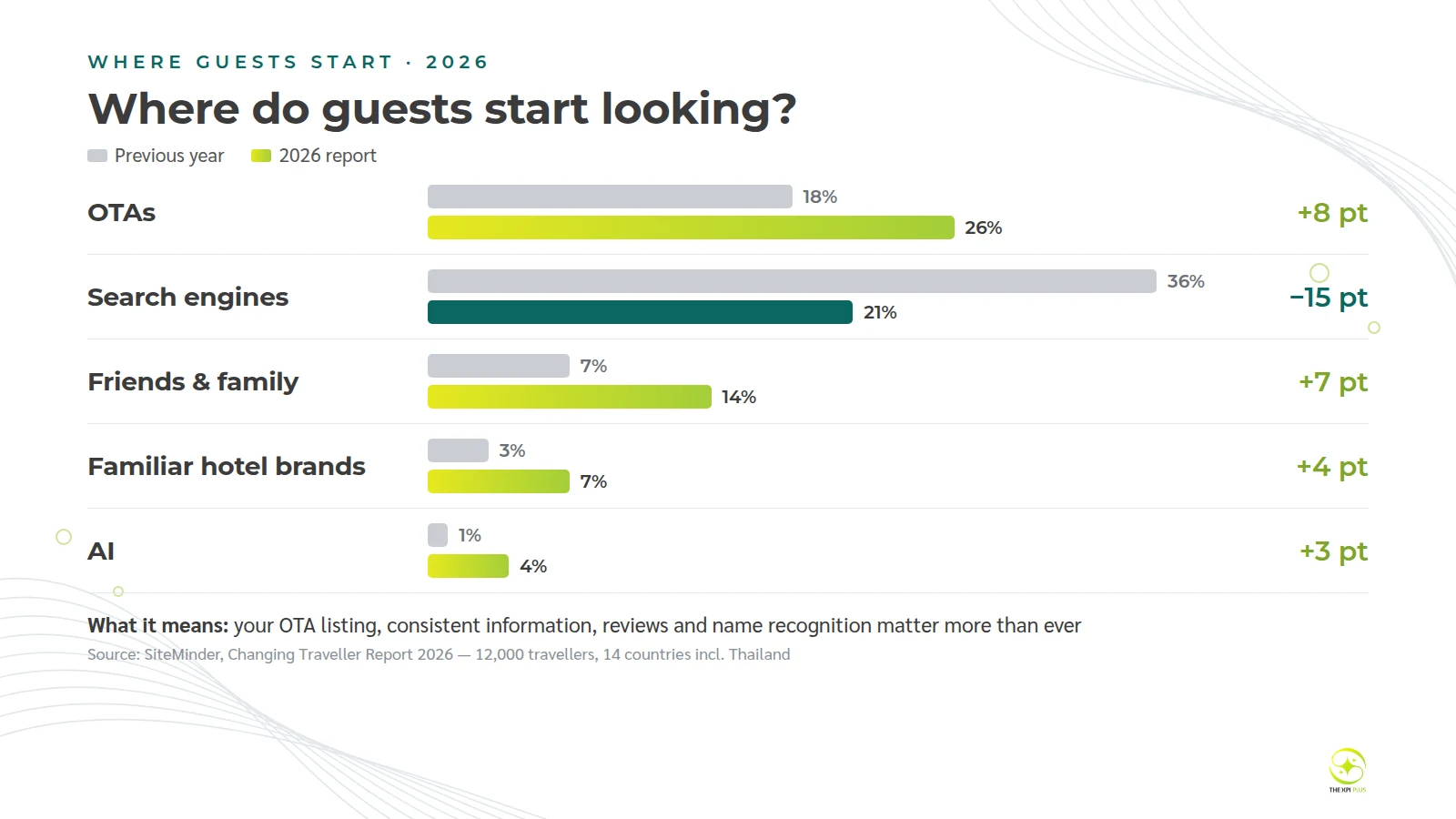
SiteMinder's Changing Traveller Report 2026, a survey of 12,000 travellers in 14 countries including Thailand, found that OTAs have overtaken search engines as the number-one place guests start looking for a hotel — 26%, up from 18% the year before — while search engines fell from 36% to 21%. The same report found that around 18% of travellers who start on an OTA end up booking directly with the hotel. Your OTA listing is therefore both a sales channel and a shop window where many guests first get to know you before they look up your website.
The other change is booking through AI. Since 27 August 2026, Google has let users in the United States search, compare and book hotels in a single conversation in AI Mode. Its first partners include OTAs such as Booking.com, Expedia, Hotels.com, Priceline and Trip.com, as well as large hotel chains. The hotel or booking platform still takes the booking and handles payment, confirmation and customer service.
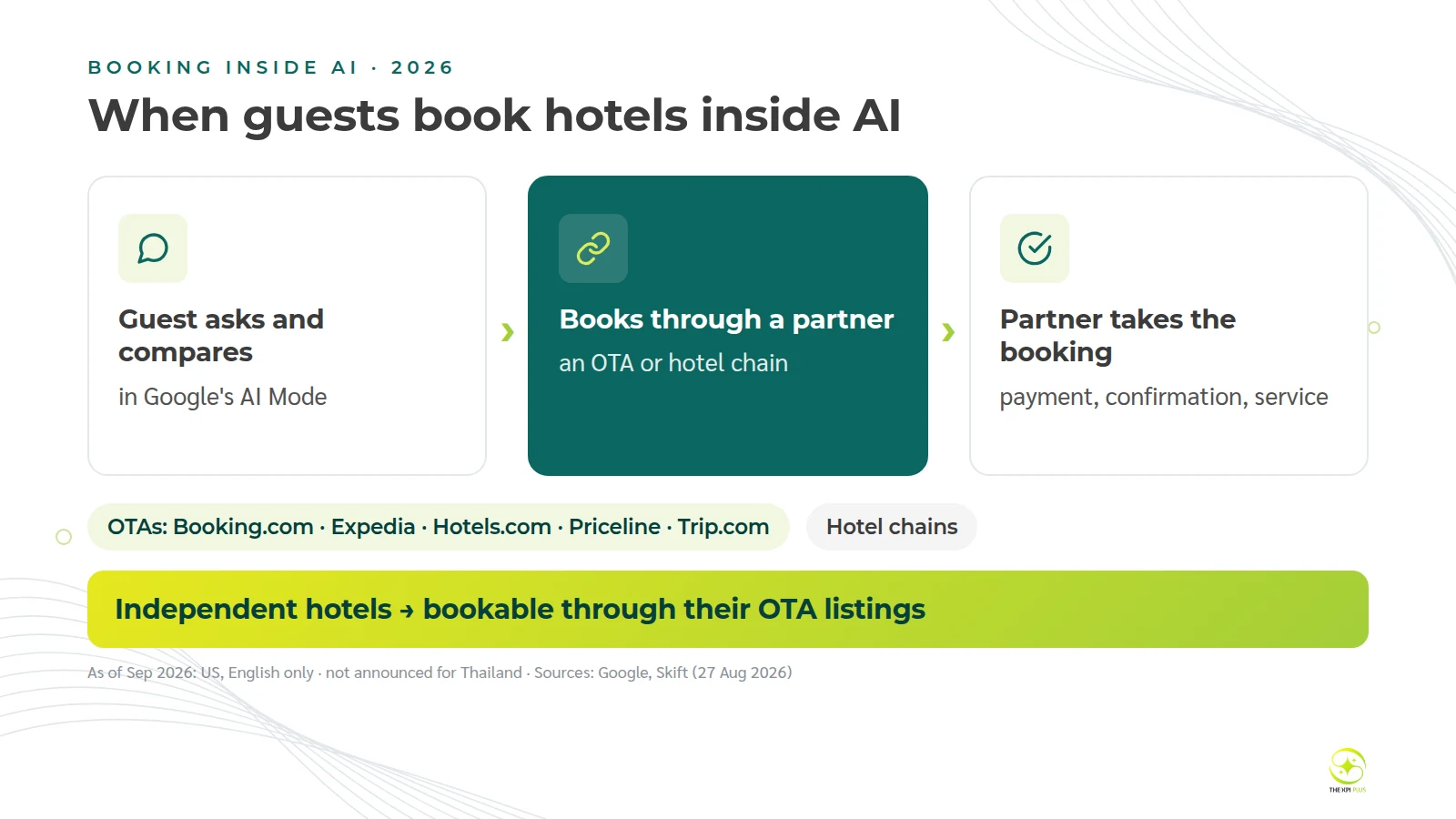
Key point: As of late September 2026 this feature is live only in the United States and has not been announced for Thailand. But the direction is clear: for independent hotels, a complete and accurate OTA listing is one of the ways to become bookable through these new channels.
What is an OTA and how does it work for a hotel?
When a hotel sells on an OTA, guests see its information, room photos, prices, availability and booking conditions on that website or app. The guest chooses dates and a room and books. The booking details are sent to the hotel directly or through a connected system, and the hotel checks and prepares the room according to the agreed conditions.
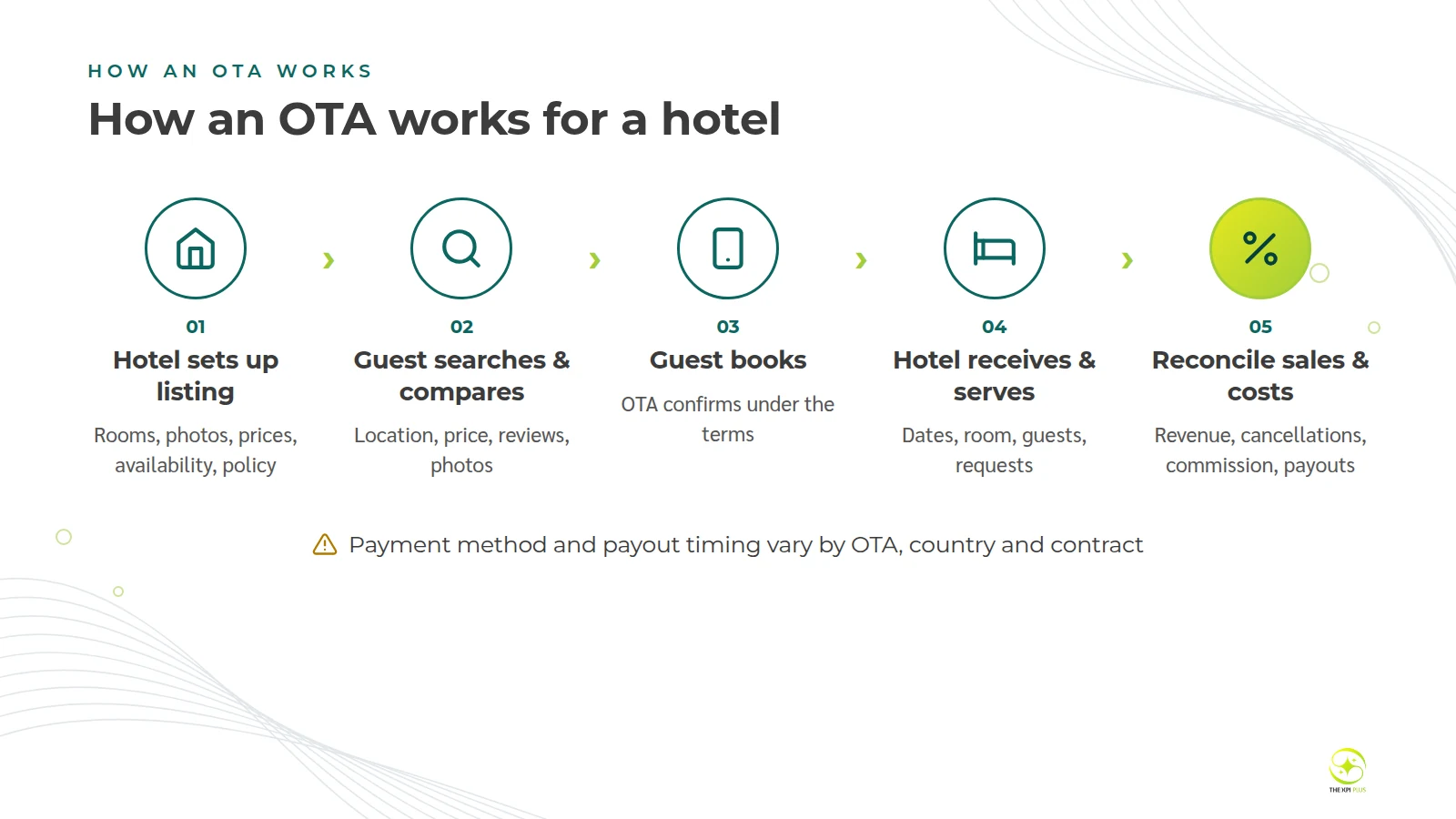
1. The hotel sets up its listing: room types, photos, prices, rooms available, cancellation policy and other conditions.
2. The guest searches and compares: location, price, reviews, room photos and facilities. Many OTAs now use AI to summarise reviews for guests.
3. The guest books: the OTA confirms the booking under the channel's conditions and the hotel's settings.
4. The hotel receives the booking and serves the guest: check stay dates, room type, number of guests, payment and special requests.
5. The hotel reconciles sales and costs: compare bookings, revenue, cancellations, commission and the money actually received in each payout cycle.
Watch out: How and when you get paid varies by OTA, country and contract type. Sometimes the guest pays the property; sometimes the platform collects payment and pays the hotel later. Read each channel's terms and reconcile carefully.
How is an OTA different from your website and direct booking system?
| Channel | Main role | What the hotel needs to watch |
|---|---|---|
| OTA | Helps people who are choosing a place to stay discover and book your hotel | Commission, promotion conditions, payment and room information |
| Hotel website | Gives official information and serves people who search for your hotel's name | Complete information, mobile speed and an easy booking process |
| Direct booking system or contact channels | Takes bookings from your website, phone, LINE or other channels you manage | Response time, room confirmation, payment collection and the cost of that channel |
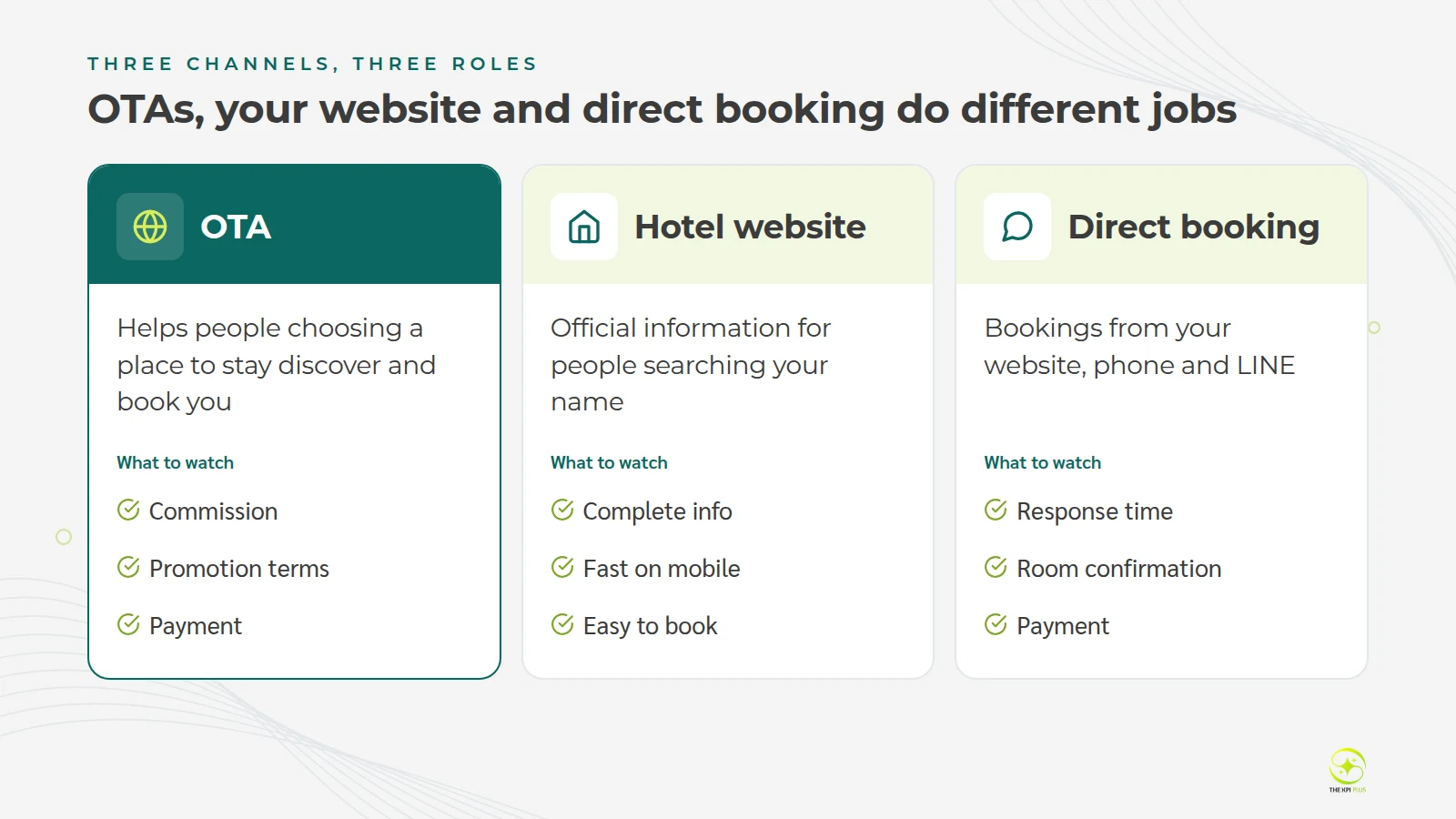
An OTA is a sales channel; a direct booking system is how the hotel takes and manages its own bookings. You can use both together as long as each has a clear role.
Some travel platforms mainly show reviews or compare prices from several sellers and send users elsewhere to book. Not every site that shows hotel prices is the same kind of OTA — check the sales model and contract of each one first.
How do OTAs help a hotel grow?
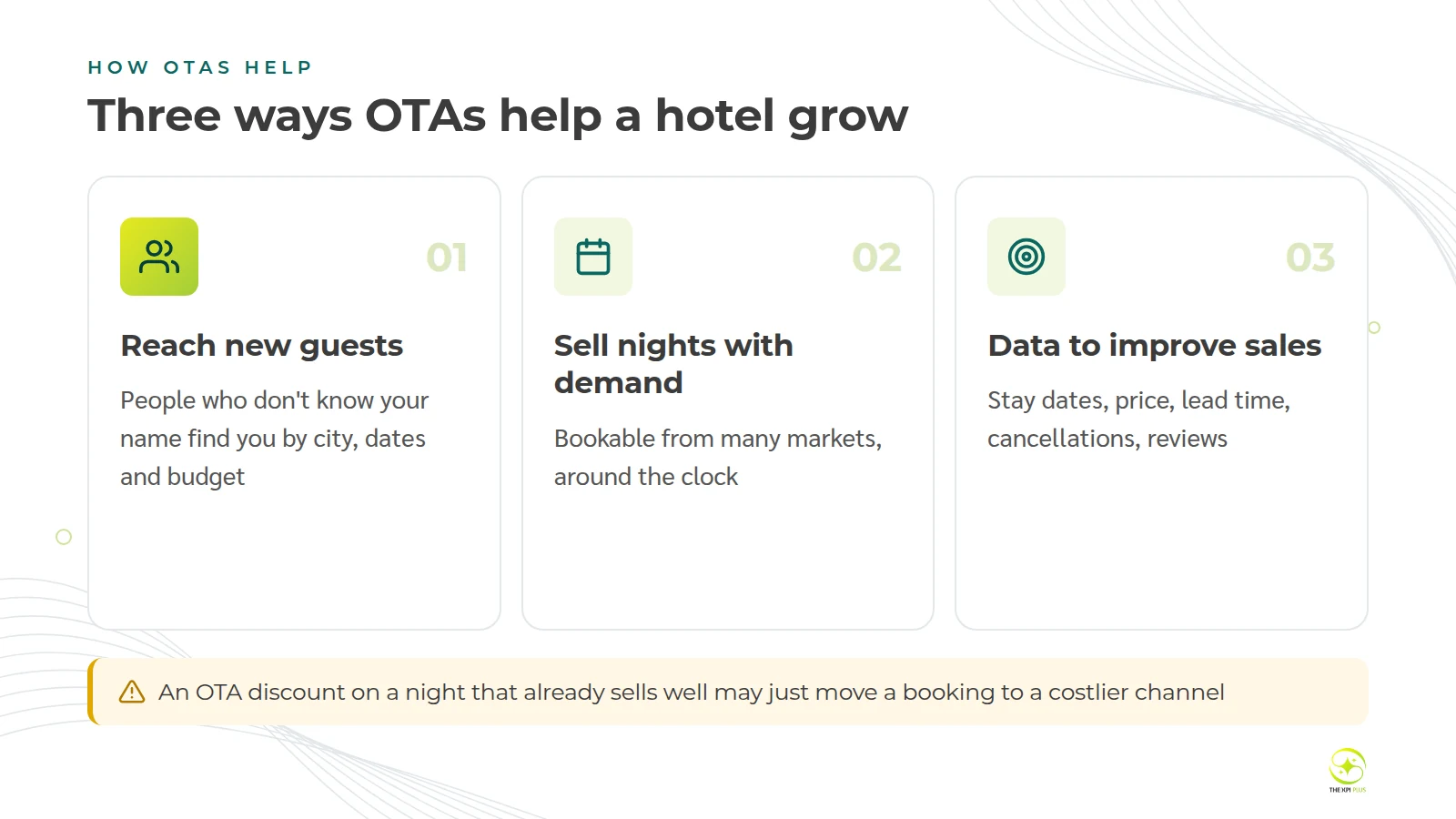
OTAs help hotels in three ways: reaching new guests, selling rooms on nights that still have demand, and providing data to improve sales.
Reaching guests who don't know you yet
Guests searching by city, area, dates and budget can discover an independent hotel on an OTA without ever having heard its name. A listing with complete photos and information is far more likely to be considered than one that leaves guests guessing — and once guests remember your name, some will come back and book directly later.
Selling rooms on nights that still have demand
OTAs let guests from many markets book at any time of day, but being listed doesn't guarantee bookings. Look at which stay dates are selling slowly, what the market price looks like, and which channels bring the right guests. If a night already sells well, adding an OTA discount may just turn an existing booking into a more expensive one.
Giving you data to improve sales
Booking volume, stay dates, selling prices, lead times and cancellations show how guests behave on each channel. Reviews and guest questions also point to the photos, descriptions or parts of the stay that need work.
That said, OTAs don't show you everything. Combine their reports with your own systems, website and direct-booking data rather than drawing conclusions from one channel's report.
How should you think about OTA commission?
Commission and other costs depend on the contract, the programmes you join and the payment model. Start from the price the room actually sold for, then deduct the channel's costs for that booking — don't apply one percentage to everything.
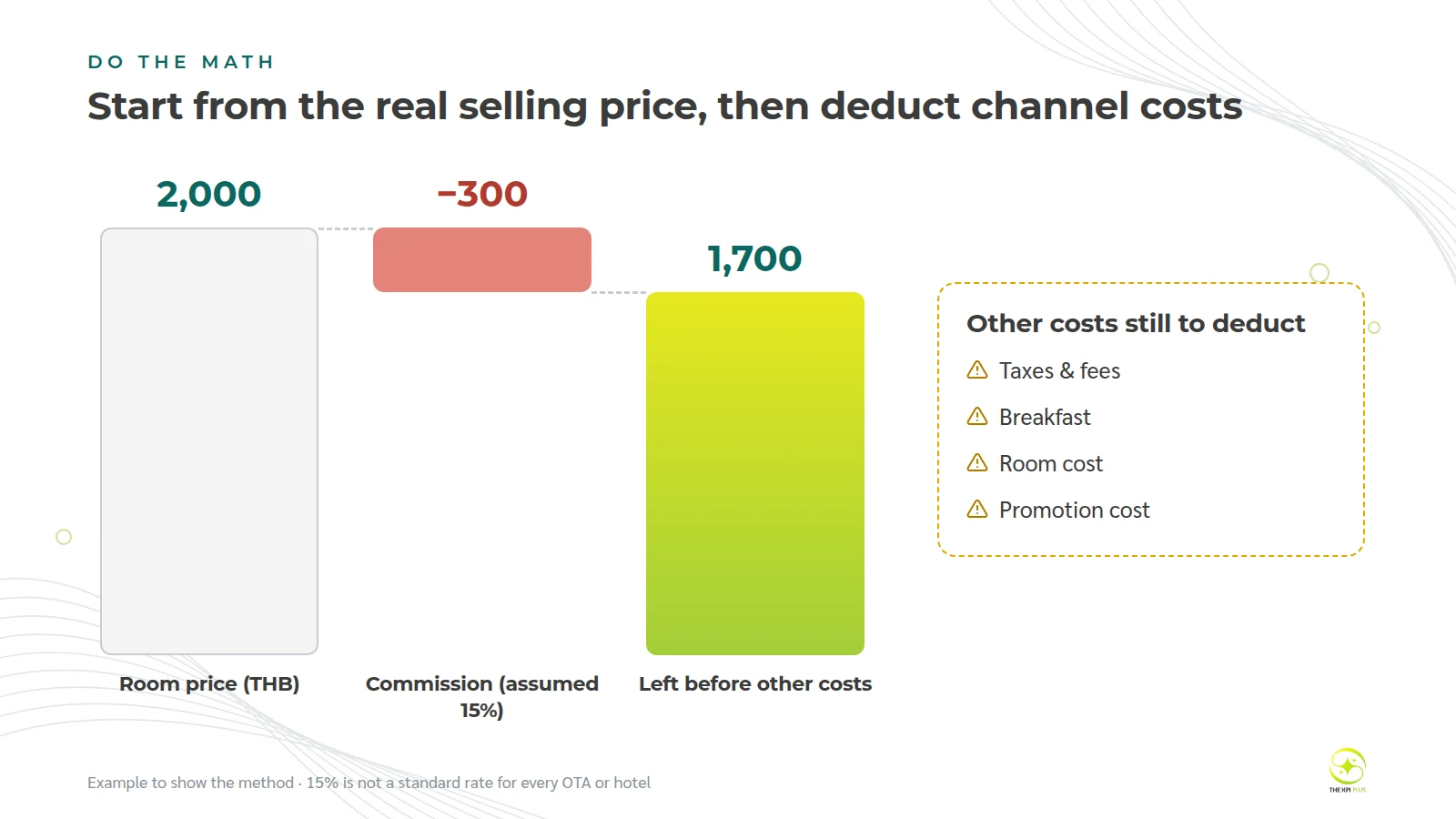
Example: If a room sells for 2,000 baht and we assume that booking carries a 15% commission, the commission is 300 baht and 1,700 baht is left — before other costs such as applicable taxes or fees, breakfast, room costs and promotion costs. The 15% here is an example, not a standard rate for every OTA or hotel.
When you review results, separate at least three figures: sales at booking price → revenue after channel costs → return after the related service costs. More bookings don't always mean the best return.
How should a hotel start selling on OTAs?
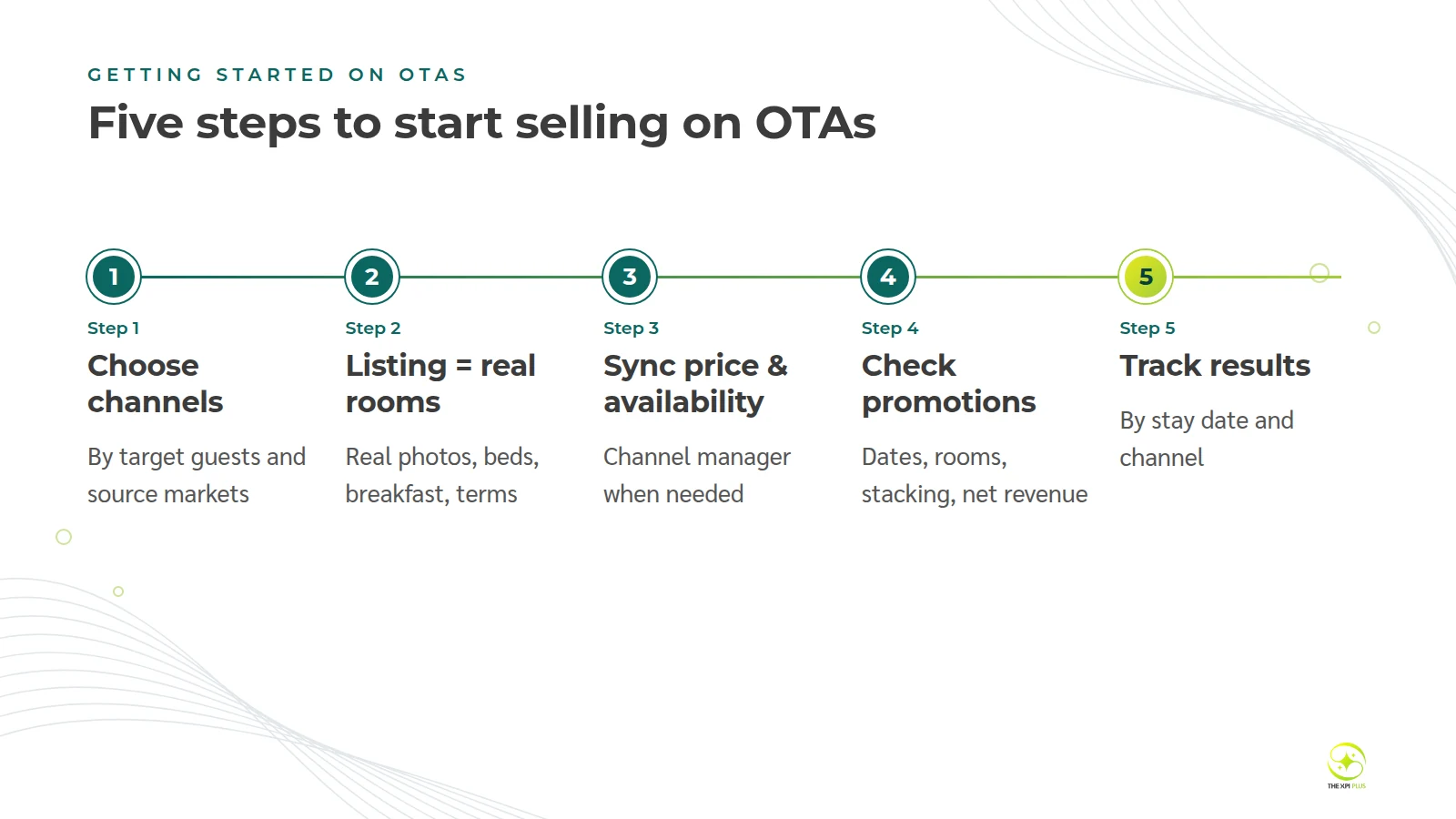
Start by choosing channels that match the guests you want, then get your listing, rates and availability right before joining any promotion.
01
Choose channels for the guests you want
Start with the channels your target guests use and your team can manage. Consider your area, source markets, property type and contract terms — there's no need to open every OTA at once. This year, also check which OTAs your main source markets prefer, as different markets favour different platforms.
02
Make your listing match the real rooms
Use clear room-type names, real photos, facilities you genuinely have and plain conditions — especially occupancy, beds, breakfast, cancellation and extra charges. Wrong information causes cancellations and poor reviews, and when search engines or AI tools summarise your listing, the mistakes travel with it.
03
Keep prices and availability in sync
Check that each night's prices, room counts and stay restrictions match your sales plan. As you add channels and bookings grow, a channel manager can reduce double work and the risk of overbooking — but someone still needs to check the settings and anything unusual.
04
Check promotions before you join
See which dates and room types a promotion covers, whether it stacks with other discounts, and how it affects the price guests see and your net revenue. Don't join just in the hope of a better ranking or more bookings without doing the maths. In a year when overall demand is flat, stacked discounts eat into revenue quickly.
05
Track results by stay date and channel
Summarise new bookings, cancellation rate, average rate and revenue after channel costs. Compare with a similar period, and adjust room allocation, prices or offers when booking behaviour changes.
Which numbers show whether OTAs are really helping?
| Number | What it tells you | What to watch |
|---|---|---|
| Room nights sold | How many nights the OTA brought in | Split by stay date, not just the total |
| Average daily rate (ADR) | The average price you sold at | Check the effect of discounts and which room types sold |
| Revenue after channel costs | What's left after commission and channel fees | This is still not the hotel's net profit |
| Cancellation rate | Bookings that didn't become stays | Look at booking conditions and lead time |
| Sales mix by channel | How much you depend on each channel | Read it together with direct bookings and each channel's cost |
If you don't yet collect all of this, start by recording bookings accurately by channel and stay date, then add cost and profit analysis step by step.
Frequently asked questions
Is an OTA the same as a channel manager?
No. An OTA is a channel guests use to search and book. A channel manager is a tool that helps the hotel send prices and availability to several channels and receive bookings back from the connected systems.
Does a small hotel need to be on every OTA?
No. Choose the channels that bring the right guests and that your team can keep accurate — information, prices and bookings. Opening many channels with inconsistent information adds work and raises the risk of overbooking.
If we sell through OTAs, do we still need a hotel website?
Yes. Many guests find a hotel on an OTA and then search for its name before booking. Your website explains your strengths, conditions and how to book directly, while OTAs keep bringing you new guests.
Will AI make OTAs less important?
Not for now. When Google launched hotel booking in AI Mode in the United States in late August 2026, its first partners included major OTAs as well as hotel chains. For independent hotels, a well-maintained OTA listing remains one of the ways to be bookable through these new channels — alongside complete, consistent information everywhere.
Summary
OTAs help hotels get seen and take bookings from new guests, and in 2026 they are where more guests start their search than anywhere else. But profitable growth means looking beyond the number of bookings: watch price, availability, commission, cancellations and revenue after channel costs, and give OTAs, your website and direct bookings clear roles that work together. For the bigger picture across all channels, read What Is Hotel Marketing?
If you'd like to check whether your room prices, listings and OTA channels are producing the right revenue, request a Hotel Performance Audit with The KPI Plus team. To compare revenue by channel, see revenue and commercial management or try the OTA commission calculator (in Thai).
Related reading: Hotel Rate Parity and Increase Hotel Bookings from Google.