SEO, Google Maps & AI Search

Help customers find the business, see why it fits, and contact you at once

People no longer search only the hotel or shop name. They may ask for “a couples massage spa near me”, “a quiet café in Phuket”, or “a hotel near the airport with late check-in”, then read an AI answer, open Google Maps, check reviews, and compare the website before they decide.

  • Search visibility starts with clear and consistent business information
  • Google Maps and the website must support the same customer decision
  • Search and AI answers should lead to a useful business page
  • The path should connect to contact or booking where it can be measured

Send the business name, a website or Google Maps link, and the issue you see.

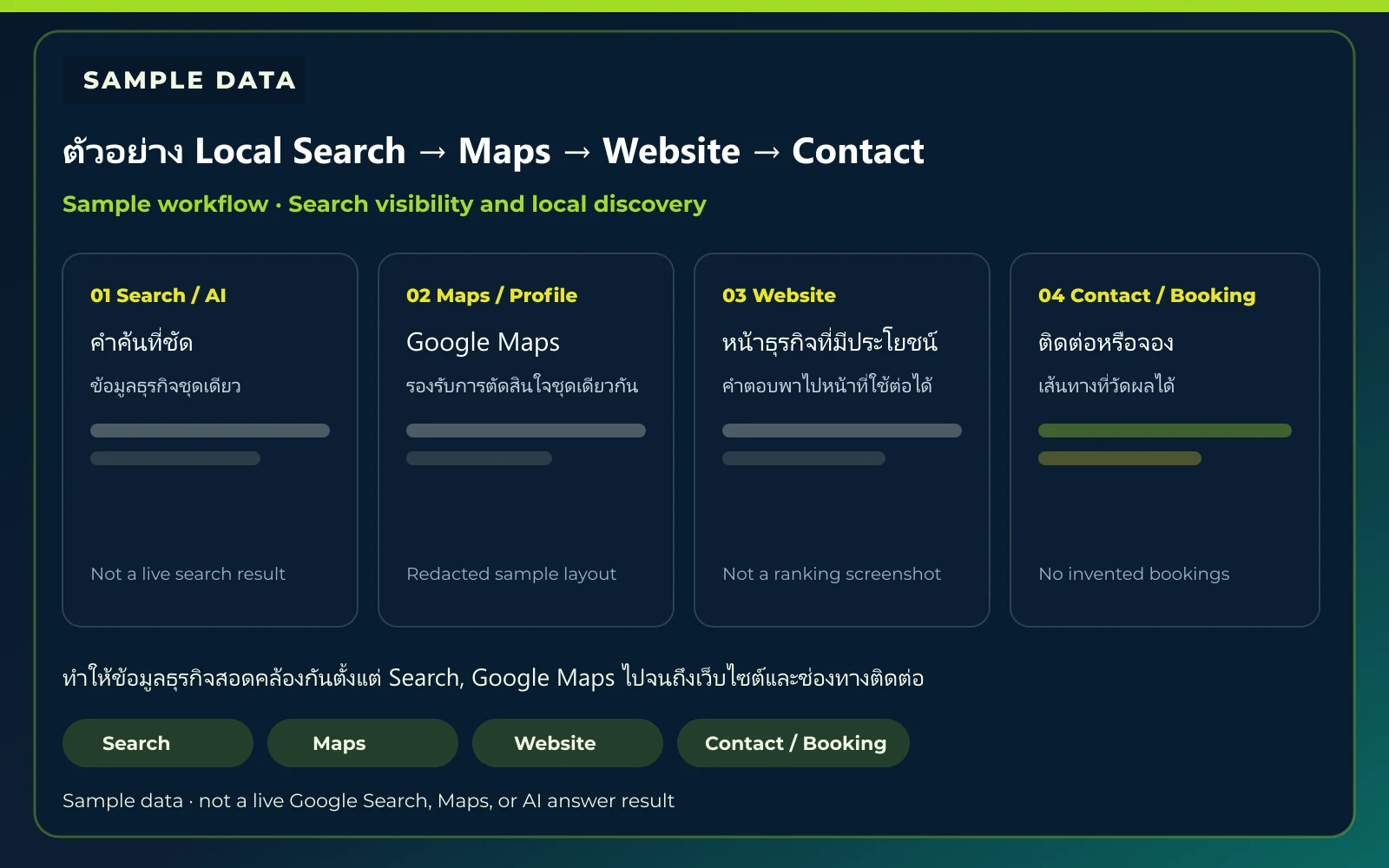
01 Search02 Maps03 Website04 Contact / Booking

Sample Local Search path from Search to Google Maps, the website, and contact or booking. Not a live hotel resultSample Visual
Sample Local Search → Maps → Website → ContactSample workflow · Search visibility and local discoveryKeep business facts consistent from Search and Google Maps through to the website and the contact path

Search Behavior

Search behaviour is changing

Customers start with a question, then may use Traditional Search, AI Search, Google Maps, or the website before they call, get directions, contact, or book.

  • 01

    Traditional Search

    The customer types a query, then opens a page that answers the service, location, or price.

  • 02

    AI Search / AEO

    The customer asks a longer question. A system may summarise clear facts. A business is not guaranteed to appear in every answer.

  • 03

    Google Maps / Local Search

    The customer checks distance, hours, reviews, and directions before travelling.

  • 04

    Website and contact / booking path

    The business page must support the decision, then connect to a call, directions, contact, or booking.

Search Behavior Map

  1. Customer question
  2. Search / AI Search
  3. Trusted business information
  4. Maps / Website
  5. Call / Directions / Contact / Booking

AI Search use is growing worldwide

1 billion

monthly AI Mode users worldwide, according to Google in 2026

This figure shows growth in the search format. It is not the number of users in Thailand.

Source: blog.googlehttps://blog.google/intl/th-th/products/consumer-products/search-io-2026/Published 2026 · Accessed 2026-10-27 · Worldwide · 2026, worldwide monthly users as reported by Google · Platform estimate, not a hotel resultGoogle reported about 1 billion monthly AI Mode users worldwide in 2026. This is a global platform estimate, not Thailand usage and not a hotel campaign result.

Google Maps still matters for local decisions

Google says local business results consider three main factors: relevance, distance, and prominence. A complete, accurate Business Profile helps customers see what the place does, where it is, and when it is open.

Source: Google Business Profile Helphttps://support.google.com/business/answer/7091?hl=enAccessed 2026-10-27 · Global guidance · Guidance as accessed 27 Oct 2026 · Product guidance, not a hotel resultGoogle lists relevance, distance, and prominence as the main local ranking factors. This is product help, not a hotel Maps rank.

For hotels, spas, and cafés this means the website and Google Maps have to answer the same questions clearly: the service, the location, the price, the hours, and how to book.

The usual SEO work still applies to AI Overviews and AI Mode. There is no special method that guarantees a business will appear in every AI answer or AI Overview. Visibility varies by query, location, language, user context, source quality, and search-system changes.

Source: Google Search Centralhttps://developers.google.com/search/docs/appearance/ai-featuresPublished 2025 · Accessed 2026-10-27 · Global guidance · Guidance as accessed 27 Oct 2026 · Product guidance, not a hotel resultGoogle’s public guidance that usual SEO work still applies to AI Overviews and AI Mode. Not a hotel ranking result.

How do SEO, AEO, and Local SEO differ?

These are not alternatives. The website, the business facts, and the answers customers need should work together.

All three areas should use the same verified business information so Search, AI, Maps, and the Website describe the business consistently.

Does any of this sound like the business now?

  1. 01
    Problem
    The hotel has a website, but customers do not find the relevant page
    What the customer sees
    A search for the service or area does not open the hotel page that answers the question
    Data to inspect
    Search Console queries and pages, target landing pages, internal links
    Recommended output
    A search-ready page that answers the query and continues to contact or booking
  2. 02
    Problem
    Customers see the business on Maps, but key information is outdated
    What the customer sees
    Hours, phone, services, or photos do not match what the business currently offers
    Data to inspect
    Google Business Profile, NAP, hours, photos, and services compared with the website
    Recommended output
    A local listing that matches the website
  3. 03
    Problem
    Customers reach the website, but price, service, hours, photos, or reviews are unclear
    What the customer sees
    They cannot find the facts needed to contact or book, so they leave
    Data to inspect
    Service pages, the contact or booking path, and whether content and photos are complete
    Recommended output
    A business page people can use to decide the next step
  4. 04
    Problem
    The business has reviews, but does not use customer questions and language to improve its information
    What the customer sees
    The same questions appear in reviews, but the website or profile still does not answer them
    Data to inspect
    Review themes with author names redacted, FAQs, and service descriptions
    Recommended output
    Business facts that answer the questions customers already ask
  5. 05
    Problem
    The hotel does not know whether customers discovered it through Search, Maps, or AI
    What the customer sees
    People contact the business or open the site, but the team cannot see which path they used
    Data to inspect
    Search Console, Google Business Profile data where access exists, and enquiry source
    Recommended output
    A reviewable discovery view. Not invented rankings, calls, or bookings
Ask the team to look at what to fix first

Why a complete, current Google Business Profile supports local discovery

Customers usually check distance, hours, the service, photos, and reviews before they travel or make contact. A complete, current profile helps those facts appear on Search and Maps at the decision point.

A complete profile can support that decision. It does not guarantee a Maps rank or the top Maps position. Local results still depend on relevance, distance, and prominence.

Call

The customer can call from the profile

Directions

The customer can ask for directions

Website Visit

The customer can open the website

Contact

The customer can send a question or message

Booking

Booking intent, only if a booking event can be measured

Discovery should lead to a call, directions, a website visit, contact, or a booking when that path can be measured. Being seen by name is not the end of the path.

Source: Google Business Profile Helphttps://support.google.com/business/answer/7091?hl=enAccessed 2026-10-27 · Global guidance · Guidance as accessed 27 Oct 2026 · Product guidance, not a hotel resultGoogle lists relevance, distance, and prominence as the main local ranking factors. This is product help, not a hotel Maps rank.

How the work starts

What can be measured?

Separate website, Google Business Profile, and business outcomes. Search impressions are not revenue. Profile views are not bookings. Public figures appear only with Approved or Anonymised status. If approved data is unavailable, this Metric Framework is labelled Sample data and public KPI values stay hidden.

Maps rank and AI mentions are not guaranteed. The aim is to see whether discovery leads to contact or booking when that path can be measured. Impressions are not counted as bookings.

Hotel SEO Review

Ask the team to review how customers find this business

Send the hotel name, a website or Google Maps link, and the issue you see, so the team can review discovery, the website, the business profile, and the facts customers use to decide.

What the hotel receives from starting a Hotel SEO review

  • Current Search Visibility ReviewReview how customers currently find the business from Search, Maps, or AI, from the facts that exist. Not a ranking result
  • Website and Google Maps ReviewReview the website and Google Maps to see whether business facts match and the customer can continue to contact or book
  • Google Business Profile ReviewReview the business profile, category, hours, photos, reviews, and contact links when access exists
  • Customer Decision Information ChecklistA checklist of facts customers use to decide, such as address, hours, services, price, and contact paths
  • Quick Wins and Prioritized Action PlanA short list of what can be fixed first and what to do next, without a promised rank or booking result
  • Measurement and Tracking PlanPlan how discovery, contact, or booking can be reviewed from systems already in place. Impressions are not revenue

What Happens Next

  1. Review how customers currently find the business
  2. Review the website and Google Maps
  3. Review the facts customers use to decide
  4. Summarise quick wins and what to adjust first

Search Console or a complete set of systems is not required to start

Contact details

Hotel / company

The hotel website link, if you have one

The profile or Google Maps link, if you have one

Issue and desired outcome

A short note on what you want the team to look at first

We’ll use your name, contact details and message to answer your enquiry and get back to you. Please don’t include sensitive information such as health details. See our Privacy Notice

Or talk to the team directly info@thekpiplus.com · +66 82 635 6266

Frequently asked questions