Hotel Marketing
Hotel Social Media: Choosing the Right Channels for Your Guests and Booking Goals (2026 Update)
Hotel social media in 2026: Facebook, Instagram, TikTok, YouTube, LINE and X compared, how to choose channels and turn posts into bookings.
In this article
2026: which platforms Thais use, and why social matters more for hotels
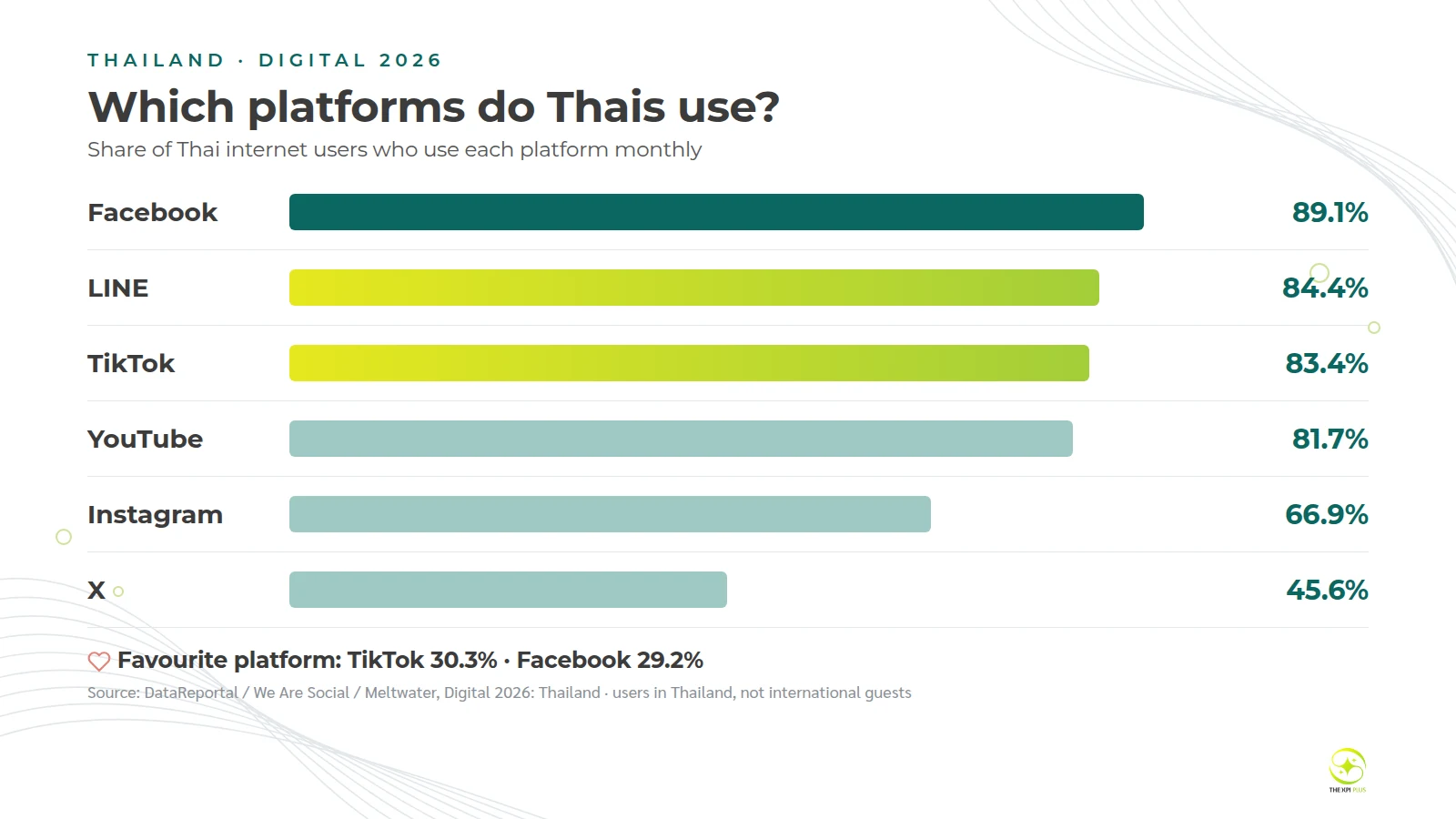
DataReportal's Digital 2026: Thailand report counts 56.6 million social media user identities in Thailand in October 2025 — about 79% of the population. Looking at the share of Thai internet users on each platform, Facebook still leads at 89.1%, followed by LINE at 84.4%, TikTok at 83.4%, YouTube at 81.7%, Instagram at 66.9% and X at 45.6%. When asked for their favourite platform, Thais put TikTok first (30.3%), just ahead of Facebook (29.2%).
At the same time, SiteMinder's Changing Traveller Report 2026 found that the share of travellers who start their hotel search with a recommendation from friends and family doubled in a year, from 7% to 14%. What guests post, share and recommend on social media now carries more weight in the decision.
Key point: These figures describe users in Thailand, so they are a good guide for domestic guests. International guests from some markets rely mainly on their own country's platforms — Chinese travellers, for example, often use Xiaohongshu and Douyin. Compare with your own source-market mix before choosing channels.
Three questions before you choose a channel
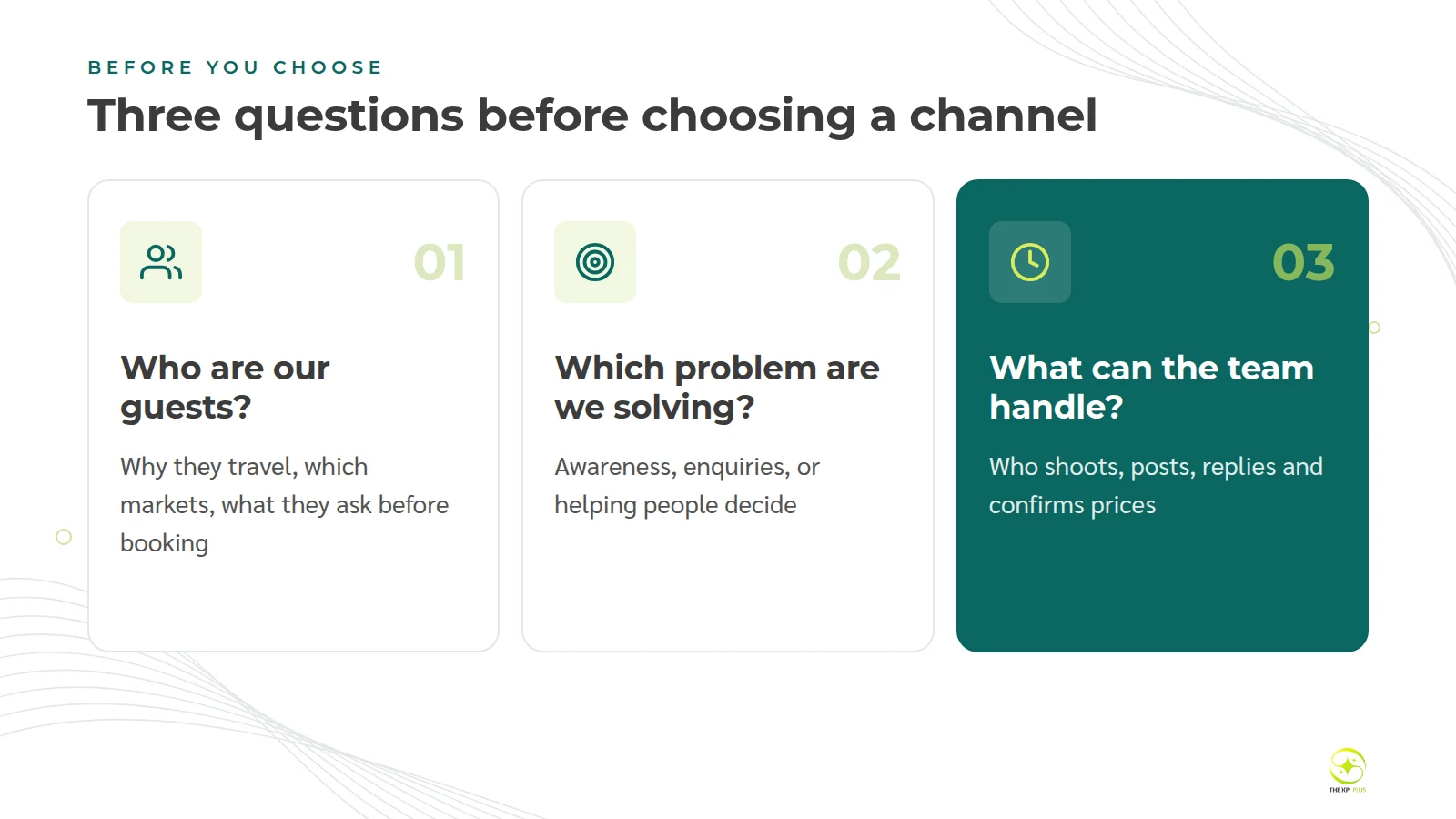
1. Who are our guests and why do they travel? Look at real bookings, source markets, chat questions, reviews and data guests have agreed to share.
2. Which problem are we solving? Building awareness, getting more enquiries, or helping people who are comparing options decide to book?
3. How much can the team handle? Who takes photos, who posts, who answers messages, and who confirms prices and availability?
If you don't yet have a way to answer guests and clear room information, fix those two things before adding platforms. Posts that bring in more questions become a burden if nobody closes the booking.
Comparing hotel social media channels
| Channel | How it helps guests | Content examples | What you need in place |
|---|---|---|---|
| Check hotel information and offers; get in touch by message | Room photos, pre-booking questions, local activities | Complete page information and someone responsible for messages | |
| See atmosphere and detail through photos or short videos | Real rooms, common areas, how to get there | Photos that match reality and a path to the booking page | |
| TikTok | Discover the hotel or area through short videos | Room walk-throughs, routes from key places, local experiences | The ability to make videos regularly and check facts before posting |
| YouTube | Look at details that take time to decide on | Room tours, room comparisons, location guides | Videos that answer real questions and are kept up to date |
| LINE Official Account | Ask questions and receive information directly from the hotel | Availability answers, shortcuts to rooms and contact | Response times, a price-confirmation process and care with guest data |
| X (formerly Twitter) | News or conversation with a niche audience you genuinely have | Local event news, answering questions | Evidence that your guests actually use it |
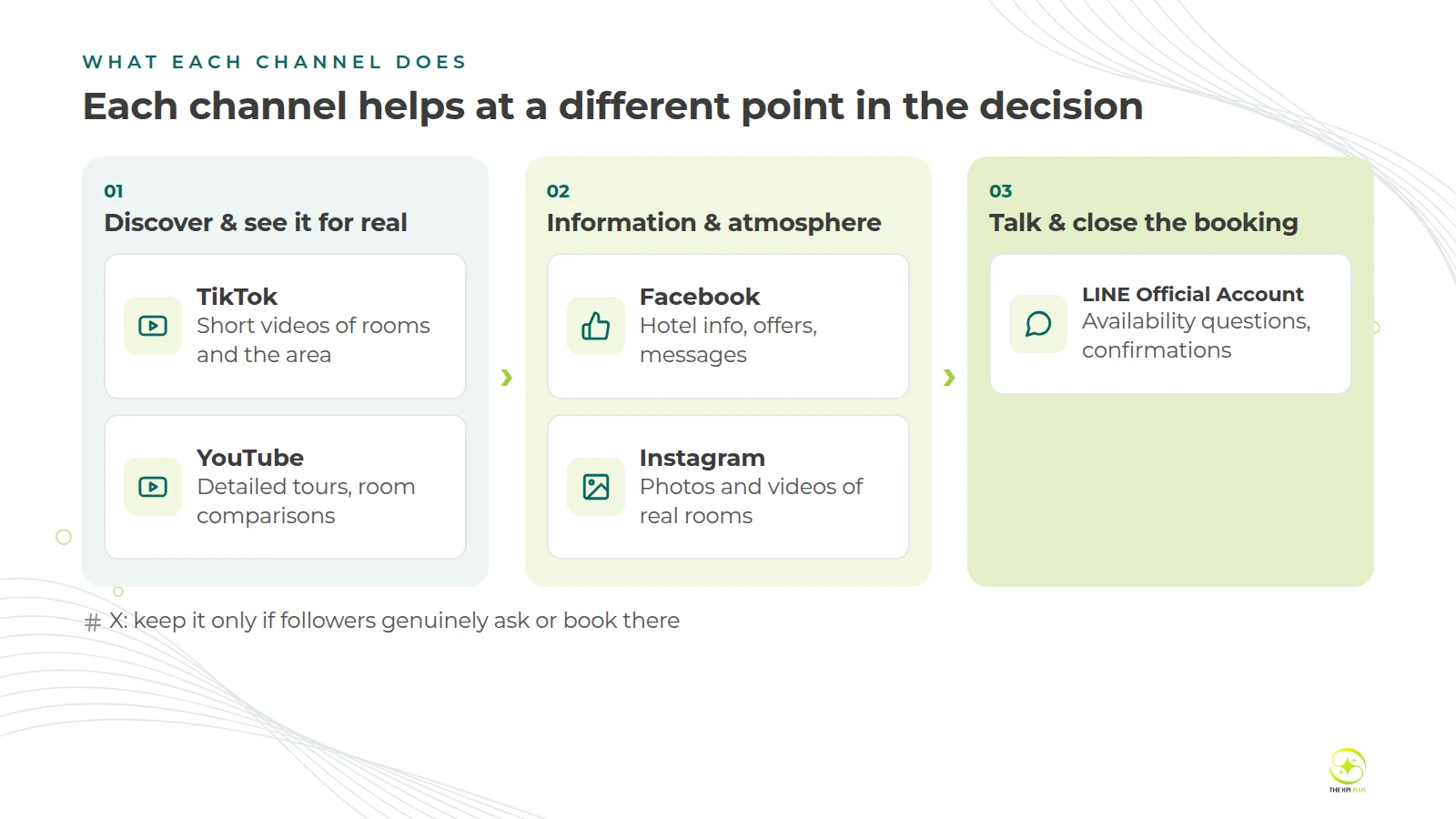
This table is a guide for choosing, not a popularity ranking or a promise of sales. Compare it with your own guest data before deciding.
Facebook and Instagram: complete information and photos that help people decide
These two channels suit hotels that want guests to see rooms, services and atmosphere, with an easy way to ask more. Facebook is still the platform most Thais use and is often where guests check that a hotel is "real". Instagram suits photos and videos that show the real space. Their exact role depends on your guests; there is no single formula for every hotel.
Start by checking that your hotel name, location, booking link, phone number and key details match your website and other listings. Then build a set of posts that answer pre-booking questions — how rooms differ, whether there is parking, or how to walk from the hotel to nearby sights.
If you use both, your team can manage messages and see some insights in Meta Business Suite, depending on how accounts are connected and which settings are supported. You still need to decide who replies and how prices are confirmed.
Measure: clicks to the booking page, enquiries that include stay dates and guest numbers, bookings from conversations and team response time. Don't use likes to judge whether it was worth it.
TikTok: show the real place through video
According to this year's report, TikTok is Thais' favourite platform. It can suit hotels with rooms, locations or local experiences that come across well in short videos — walking from the entrance to a room, showing the true room size, or following the path to the beach. A video doesn't need to go viral to be useful, but it should answer questions people use to decide.
Check the details in the clip and caption before posting. If a view is only available from some rooms, name the room type. If you film other people, get permission and respect their privacy. Put a working way to ask or book in your profile or wherever the platform allows.
Measure: profile visits, enquiries that mention the clip, clicks to booking where measurable, and bookings you can trace. Views alone may not reflect guests who are ready to travel.
YouTube: answer what still photos can't
Room tours, getting there from the airport, or comparing room types help guests look closely before deciding. Hotels that already have videos can cut short clips from them to point people to the full version — there's no need for a big production every month.
Describe what's shown accurately, and add your hotel name, location and up-to-date contact details in the right places. Links in Shorts and long videos can behave differently depending on YouTube's formats and rules, so test the path viewers actually use to contact you.
Measure: viewers who watch the important parts, questions sent after watching, and website visits or bookings you can trace.
LINE Official Account: turning conversations into bookings
LINE is the app Thais use to chat every day. For hotels whose guests already contact them on LINE, a LINE Official Account organises those conversations and sends the information guests need. A rich menu can give shortcuts to room pages, your website, your phone number or frequently asked questions, depending on the system's features.
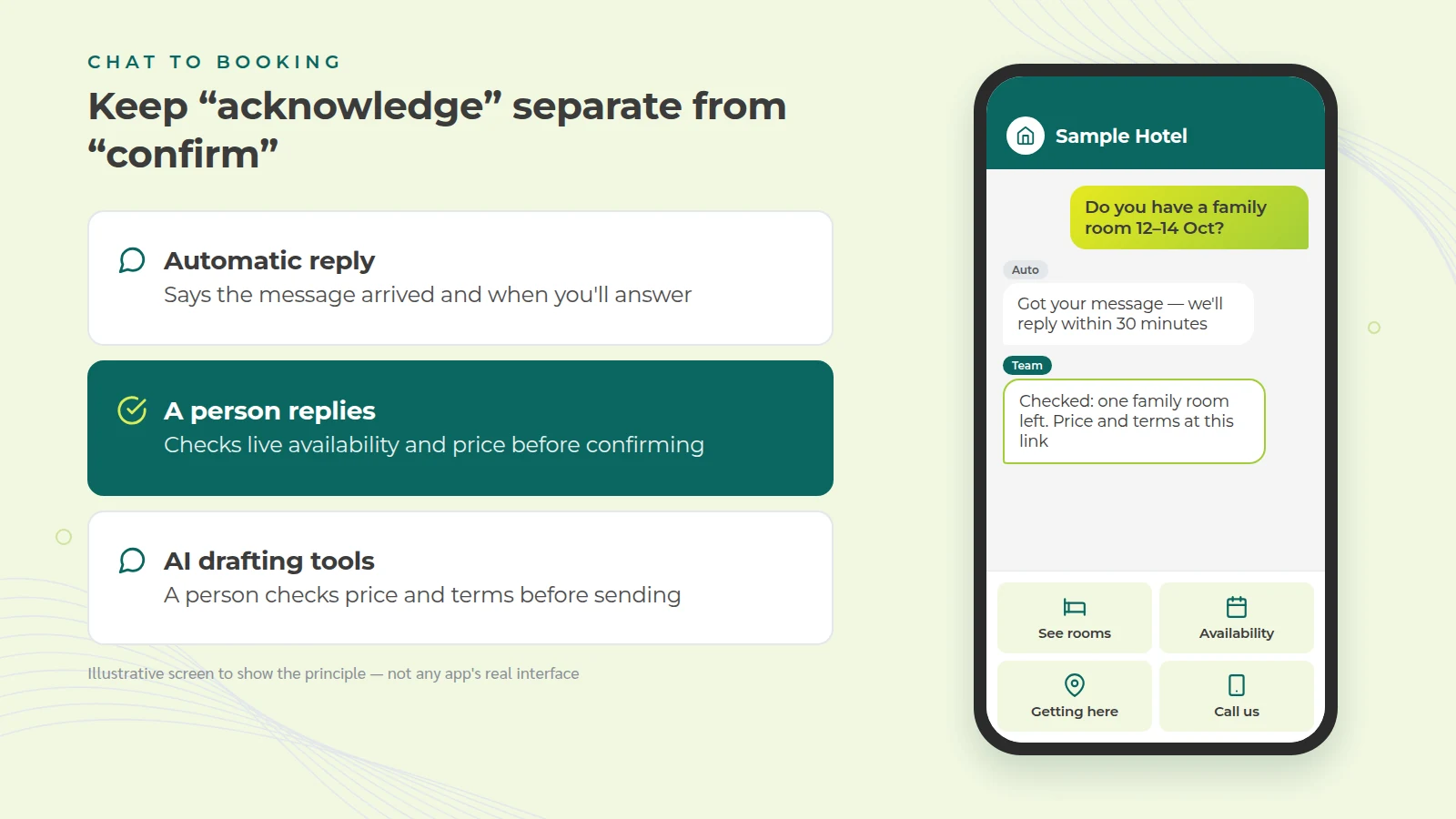
Keep acknowledging a request separate from confirming a booking. Automatic replies can tell guests when you'll respond, but should never confirm a room or price without checking the latest data. Assign someone responsible and a way to record bookings so nothing gets lost, and send promotional messages only when appropriate and wanted. If you use an AI tool to draft replies, have a person check prices and conditions before anything is sent.
Measure: enquiries with clear stay dates, the share that becomes bookings, response time and questions guests ask repeatedly.
What about X?
The original version of this article listed Twitter as a main channel. The platform is now called X, and hotels should judge it by their own guests. If you have followers who genuinely ask or book through it, and a team to handle conversations, it may be worth keeping. If not, a small team may be better off spending that time on its main channels and reply process.
Choosing platforms isn't a contest to open the most accounts — it's about matching your team's time to the way guests make decisions.
From post to booking: connect every step
Whichever channel guests find you on, the steps after they see a post should be short and clear:
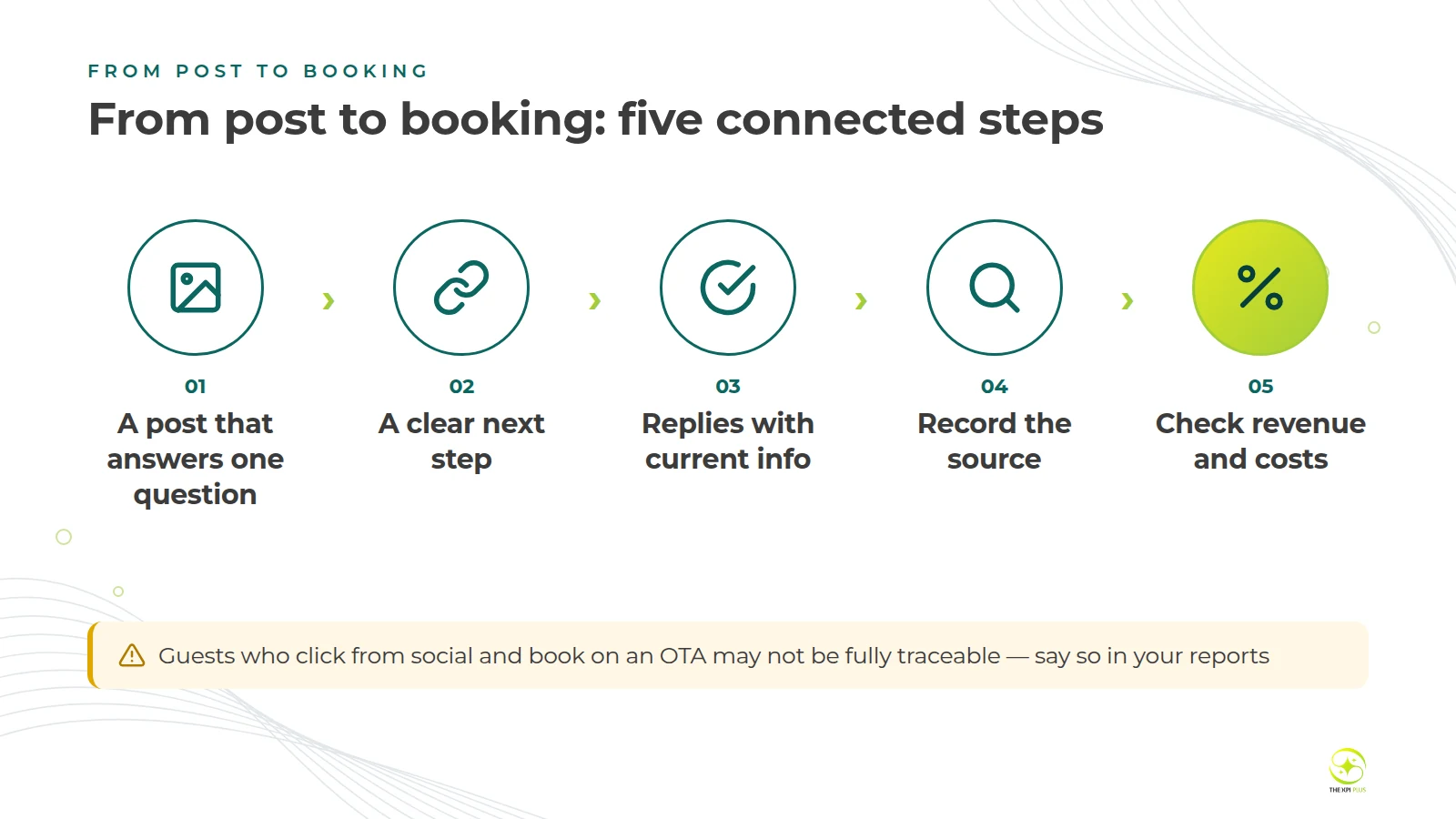
1. A post that answers one question: for example, how many people a family room sleeps, or whether you can really walk to the sea.
2. A clear next step: a room link, the booking engine or one way to ask for a price that your team monitors.
3. Replies with current information: stay dates, guest numbers, price, conditions and availability must match your sales system.
4. Record the source where you can: use trackable links, or ask guests how they found you.
5. Check revenue and costs: if you run ads, include ad spend and service costs — don't judge by the number of chats alone.
Watch out: If guests click from social media and then book on an OTA, you may not be able to trace every booking. Say so in your reports, and don't claim that all OTA bookings came from one post. Trackable links and ad pixels must follow your website's cookie consent setup.
How can a small team get started in 30 days?
| Period | What to do |
|---|---|
| Week 1 | Check information, photos, links and reply process on your existing channels. Choose only as many main channels as the team can handle |
| Week 2 | Create content from your three most common guest questions, each linked to a room page or booking path |
| Week 3 | Test post formats suited to each channel. Log incoming questions and response times |
| Week 4 | Review enquiries, bookings, revenue and time spent. Choose what to repeat or fix |
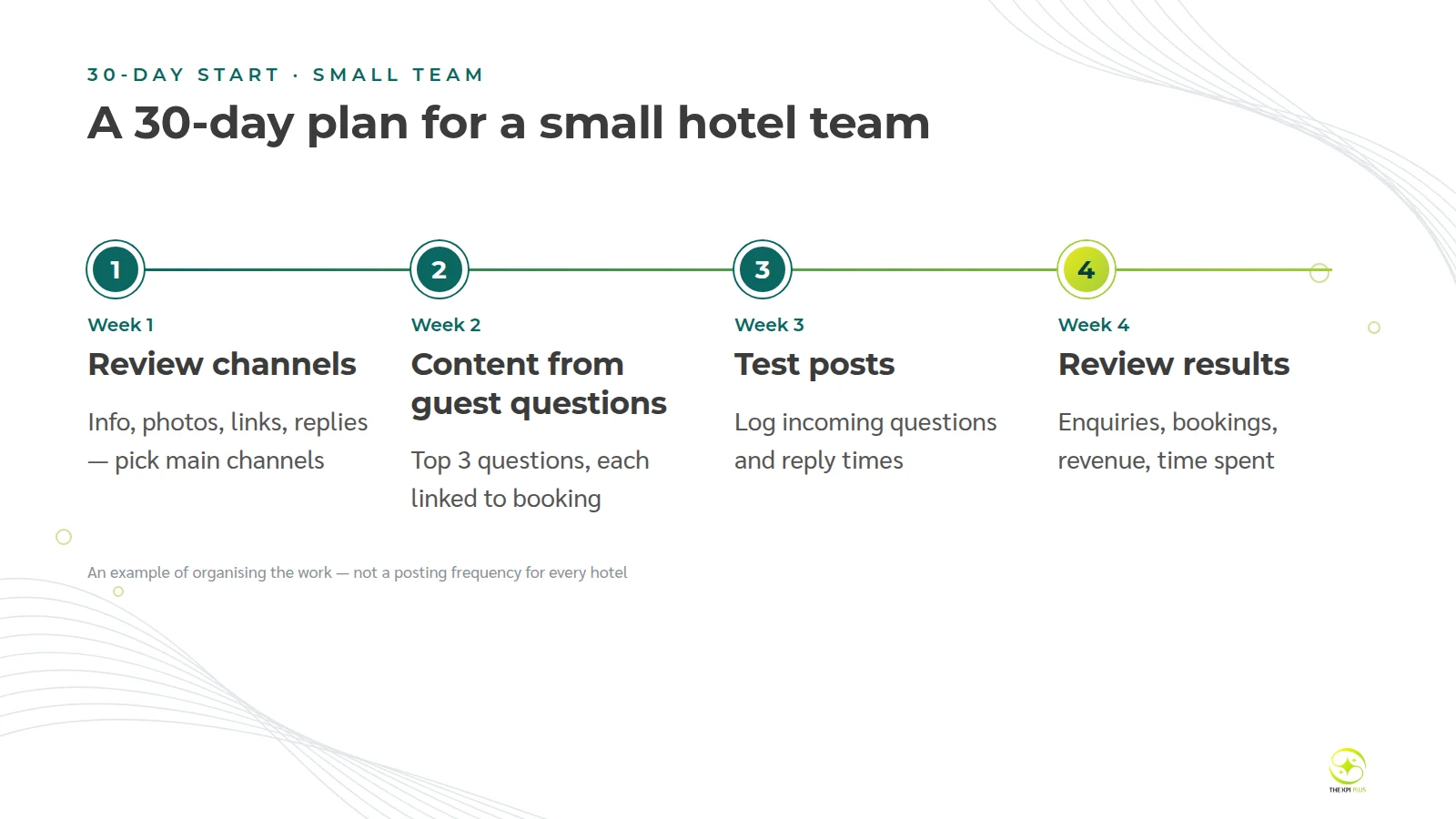
This is an example of how to organise the work, not a posting frequency that suits every hotel. Adjust it for the season, the dates you need to sell and your team's capacity.
Frequently asked questions
Does a hotel need to be on every platform?
No. Choose the channels your target guests use and that someone on your team can keep accurate and answer. Start with one or two done well, then expand when you see results and the team is ready.
How often should we post to get bookings?
No number of posts guarantees bookings. Consistency keeps information fresh, but content, price, the path to booking and response times matter just as much. Test a frequency your team can sustain at good quality and look at real results.
We get lots of views but no bookings. What should we fix?
Check whether viewers are people who can actually travel to you, whether the content makes the room type and offer clear, whether there is an easy link or way to ask, whether prices and availability match, and whether the team replies in time. High views alone don't mean people are ready to book.
Do international guests use the same platforms as Thais?
Not always. Thai usage data is a good guide for domestic guests, but guests from some markets rely mainly on their own country's platforms — Chinese travellers, for example, often use Xiaohongshu and Douyin. Check your own source-market mix before choosing channels.
Summary
Social media helps hotels get discovered, build confidence before booking and talk with guests — and in 2026, with recommendations carrying more weight, that role matters more. But the right channels depend on your guests, the content your team can make and your booking process. Use only what you can look after well, measure quality enquiries, bookings and revenue after costs, and adjust for the dates you need to sell. For the wider picture, read What Is Hotel Marketing?
If you'd like to see how your marketing channels, pricing and bookings are working together, request a Hotel Performance Audit with The KPI Plus team. For campaigns built around bookings, see Meta Ads management for hotels and our hotel digital marketing overview.
Related reading: Hotel Social Media Mistakes and Hotel Review Management.