Hotel Marketing
Hotel Organizational Structure: Departments, Roles and Systems for Independent Hotels (2026 Update)
Hotel organizational structure for independent hotels: core departments, roles by size, PMS and channel manager basics, and handovers that protect revenue.
In this article
What changed in 2026: smaller teams, the same amount of work
Thai hotels face staff shortages and tighter cash at the same time. A Thai Hotels Association (THA) and Bank of Thailand survey in November 2025 found labour shortages increasing in the central and southern regions, mainly affecting service quality. A May 2026 survey found more than half of hotels facing tighter liquidity, with some cutting staff, wages or working days, Nation Thailand reported on 19 June 2026.
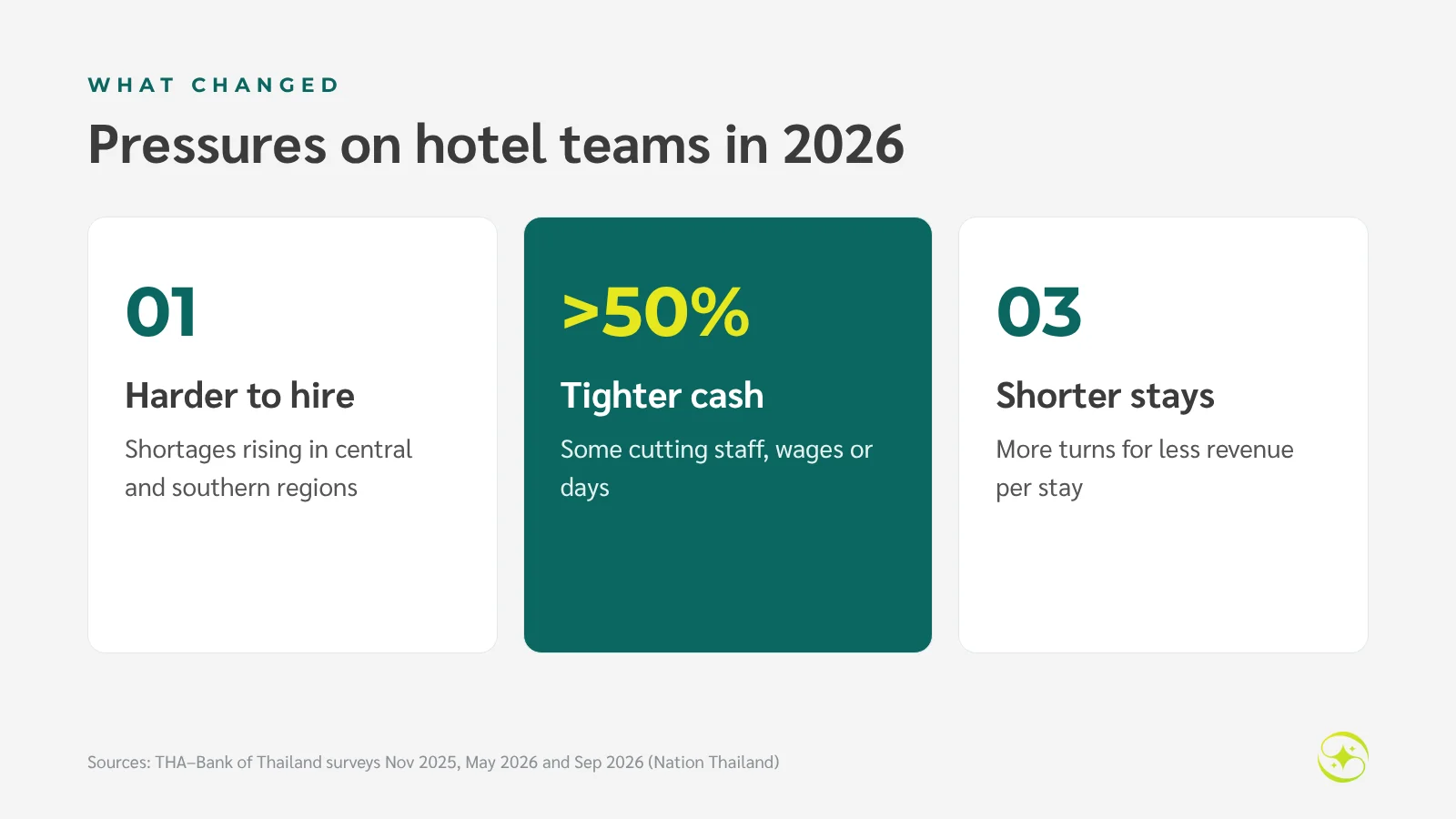
The September 2026 survey also found travellers spending cautiously and shortening their stays — meaning more check-ins, more check-outs and more room turns for less revenue per stay.
What this means for hotels: adding headcount isn't the only answer. You need a structure that makes ownership clear, systems that remove repetitive work, and staff trained to cover other roles at peak times.
What does a hotel organizational structure include?
Whether a hotel has 15 rooms or 200, its work falls into three groups that exchange information all day.
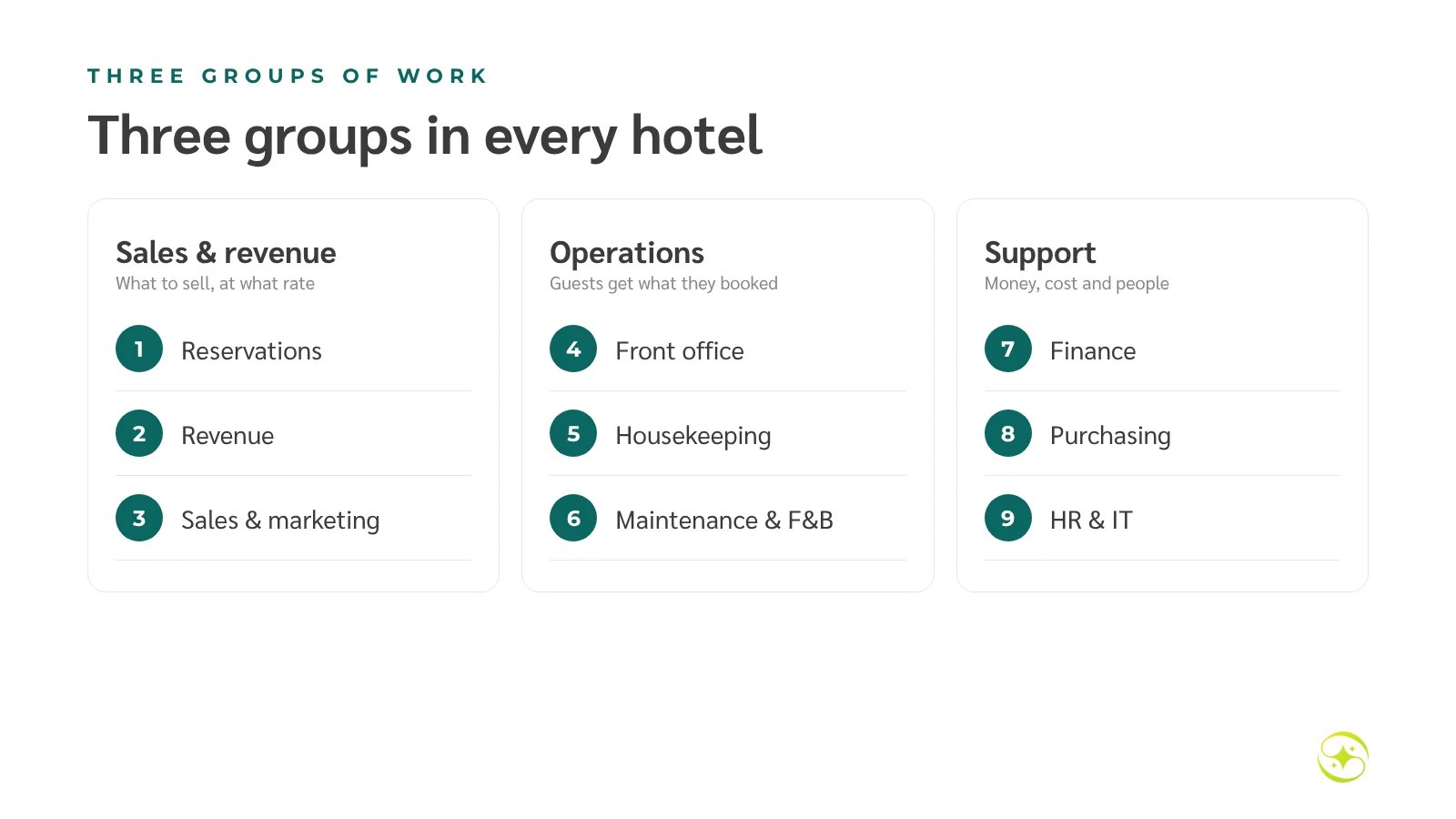
| Group | Departments or roles | Daily question |
|---|---|---|
| Sales and revenue | Reservations, sales, revenue, marketing | Which rooms do we sell, at what rate, through which channel? |
| Operations and service | Front office, housekeeping, maintenance, F&B | Is the room ready? Is the guest getting what they booked? |
| Administration and support | Finance, purchasing, HR, IT | Have we been paid? What does it cost? Do we have enough people? |
Department names vary, but every hotel needs a way to pass information across these groups. Reservations must know which rooms are out of order; accounting must know which bookings are paid.
Hotel organizational structure by size: how many people?
Headcount depends on size, service level and extras such as a restaurant or spa, but independent hotels often follow this pattern.
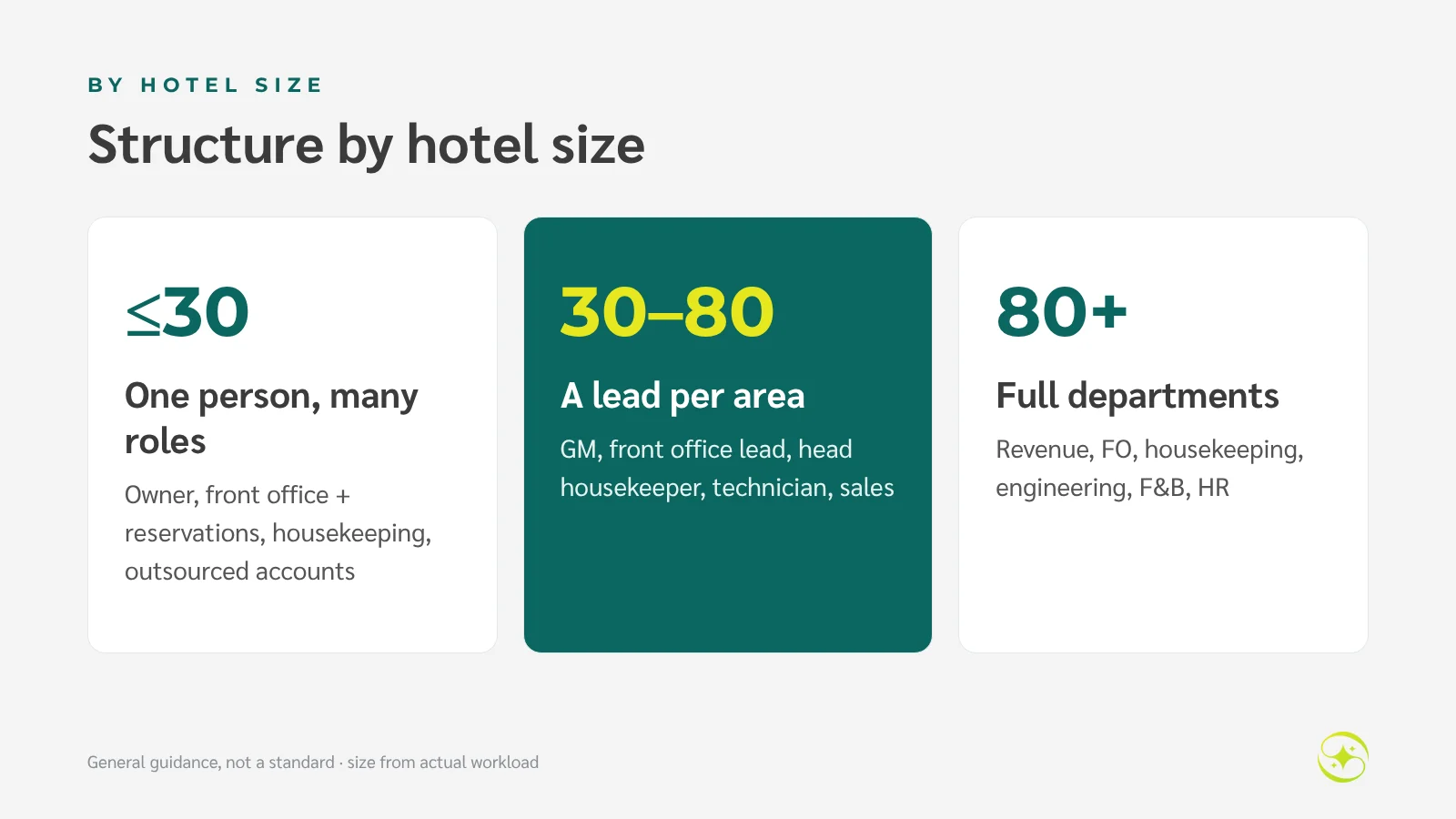
| Size | Structure | Main roles |
|---|---|---|
| Up to 30 rooms | One person, several roles | Owner or manager, front office covering reservations, housekeepers, part-time technician, outsourced accounting |
| 30–80 rooms | A supervisor per area | GM, front office lead, head housekeeper, technician, 1–2 reservations/sales, accountant |
| 80+ rooms | Separate departments | GM, revenue/sales, front office manager, executive housekeeper, chief engineer, F&B, finance, HR |
Watch out: the table is guidance, not a standard. Hotels with restaurants, spas or tour groups need more people. Size teams from actual workload — for example, rooms cleaned per housekeeper per day.
1. Sales, reservations and revenue
This group decides which rooms to sell, at what price and through which channels, and looks after each booking until arrival. In a small hotel one person may do it all, but the tasks should still be listed separately.
- **Reservations:** check dates, room type, guest numbers, payment terms and special requests
- **Rates and channels:** adjust rates and availability on OTAs and the website based on bookings on the books
- **Sales and marketing:** corporate clients, tour operators, social media and past guests
Numbers to watch: daily — new bookings and cancellations · availability for the next 30 days · rates shown on main channels
2. Front office, housekeeping and maintenance
This group makes sure guests get what they booked. The most common failure point is room status: if front office thinks a room is ready but housekeeping hasn't finished, the guest waits — and a negative review follows.
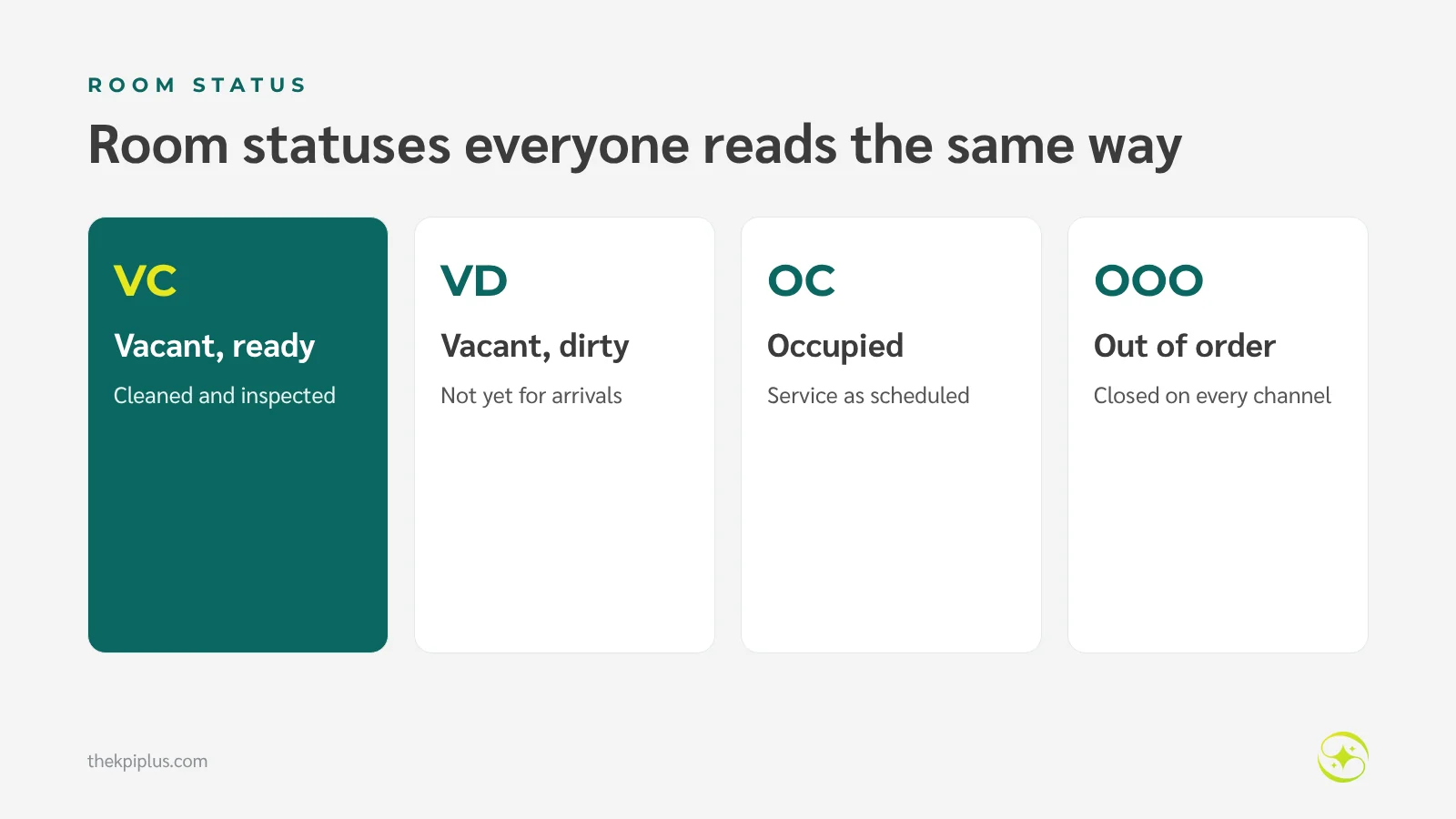
Do this: define room statuses in your system so they mean one thing across the hotel, and have housekeeping update each room as soon as it's done, not at the end of the shift. Out-of-order rooms must be closed on every sales channel too.
Hand over every shift with the same information: arrivals and departures, rooms not ready, open repairs, special requests and unresolved complaints.
3. Finance, purchasing and HR
Finance checks that every booking has been paid, OTA commission is correct, and costs stay within budget. Purchasing keeps linen, amenities and spare parts in stock. HR handles rosters, training and onboarding.
Many small hotels outsource accounting. That works, but someone in the hotel must collect documents, check daily takings, and reconcile OTA commission against invoices every month.
Numbers to watch: labour cost per occupied room · total commission per month · outstanding agent balances
4. PMS, channel manager and booking engine: what's the difference?
There's no single back-office system. Each tool does a different job, and they must connect so data matches.
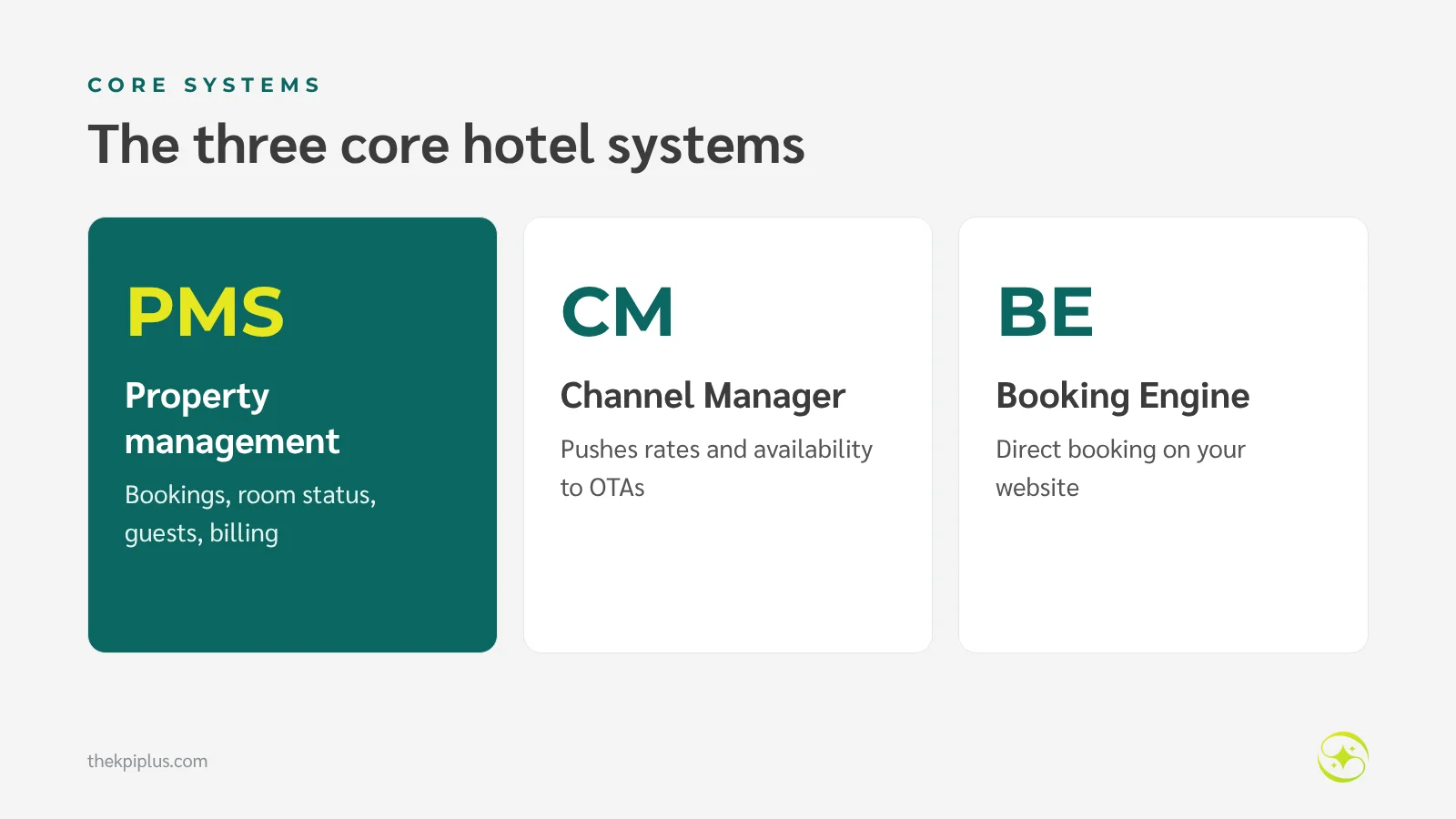
| System | Main job | Who uses it |
|---|---|---|
| PMS (property management system) | Bookings, room status, guest data, check-in/out, billing | Front office, reservations, housekeeping, accounting |
| Channel manager | Sends rates and availability to OTAs and brings bookings back | Reservations or revenue |
| Booking engine | The booking page on your own website for direct bookings | Guests (set up by sales) |
| Accounting or POS | Income, expenses, restaurant and extra sales | Accounting, F&B |
Some vendors combine several functions in one product. Before choosing or switching, start from the workflow you need and then check which system supports it — not the other way round.
5. Handing over work: one booking from reservation to check-out
Most hotel problems don't happen inside one department; they happen in the handover between departments. Follow a single booking from start to finish.
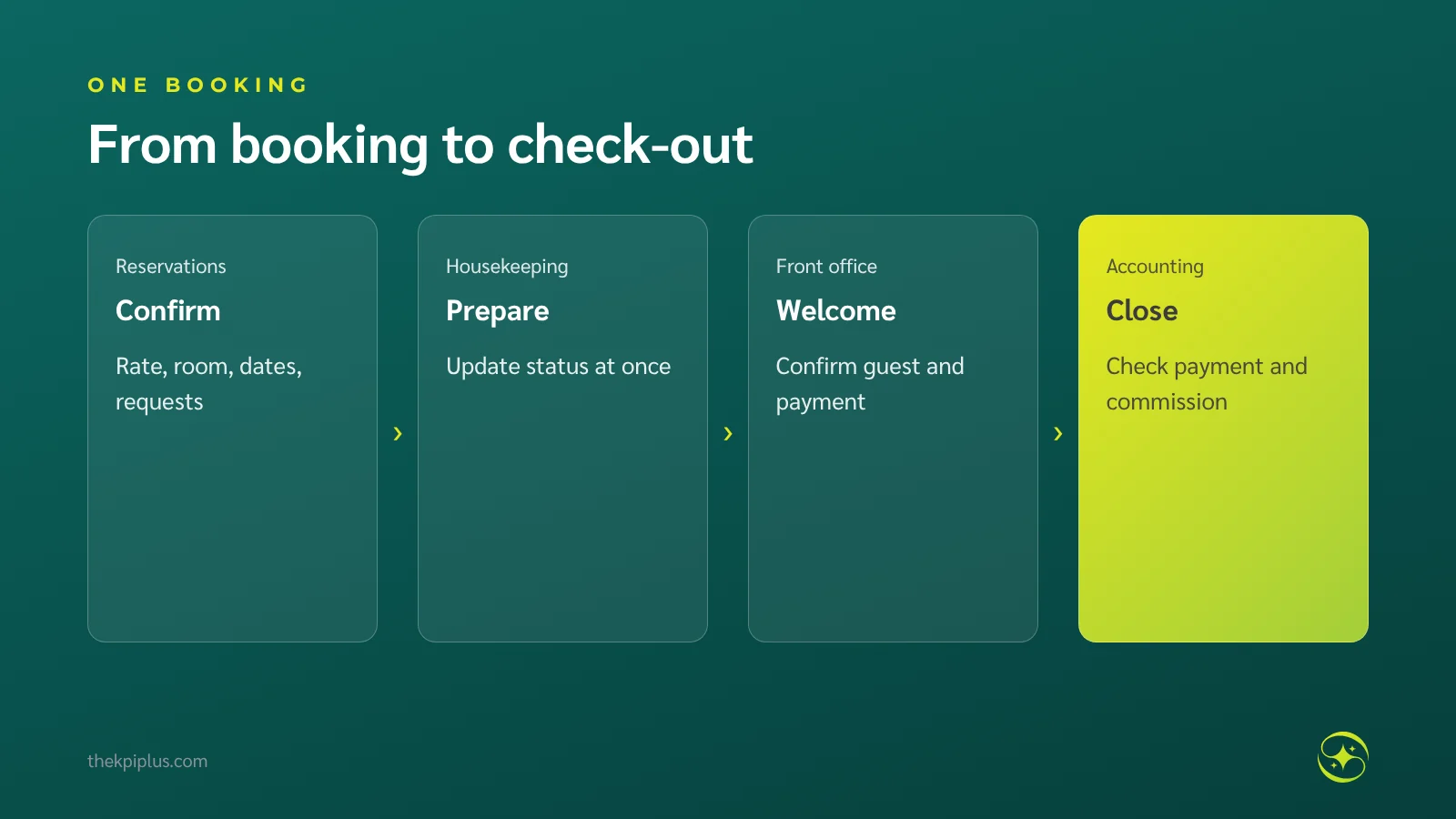
1. Booking: reservations check rate, room type, dates and requests, and record them in the PMS
2. Room preparation: housekeeping sees arrivals and requests (an extra bed, say) and updates status when ready
3. Arrival: front office confirms guest details and payment, and explains what's included
4. Closing: accounting checks payment, commission and any balance after check-out
Do this: each week, trace one real booking and check that every department received the right information. Wherever data went missing is where the process needs fixing.
6. Cross-train and meet on a fixed rhythm
In a small team, cross-training lets the hotel cope with peaks and absences — front office inspecting rooms before check-in, or reservations covering evening chat. A fixed meeting rhythm keeps information from getting stuck between departments.
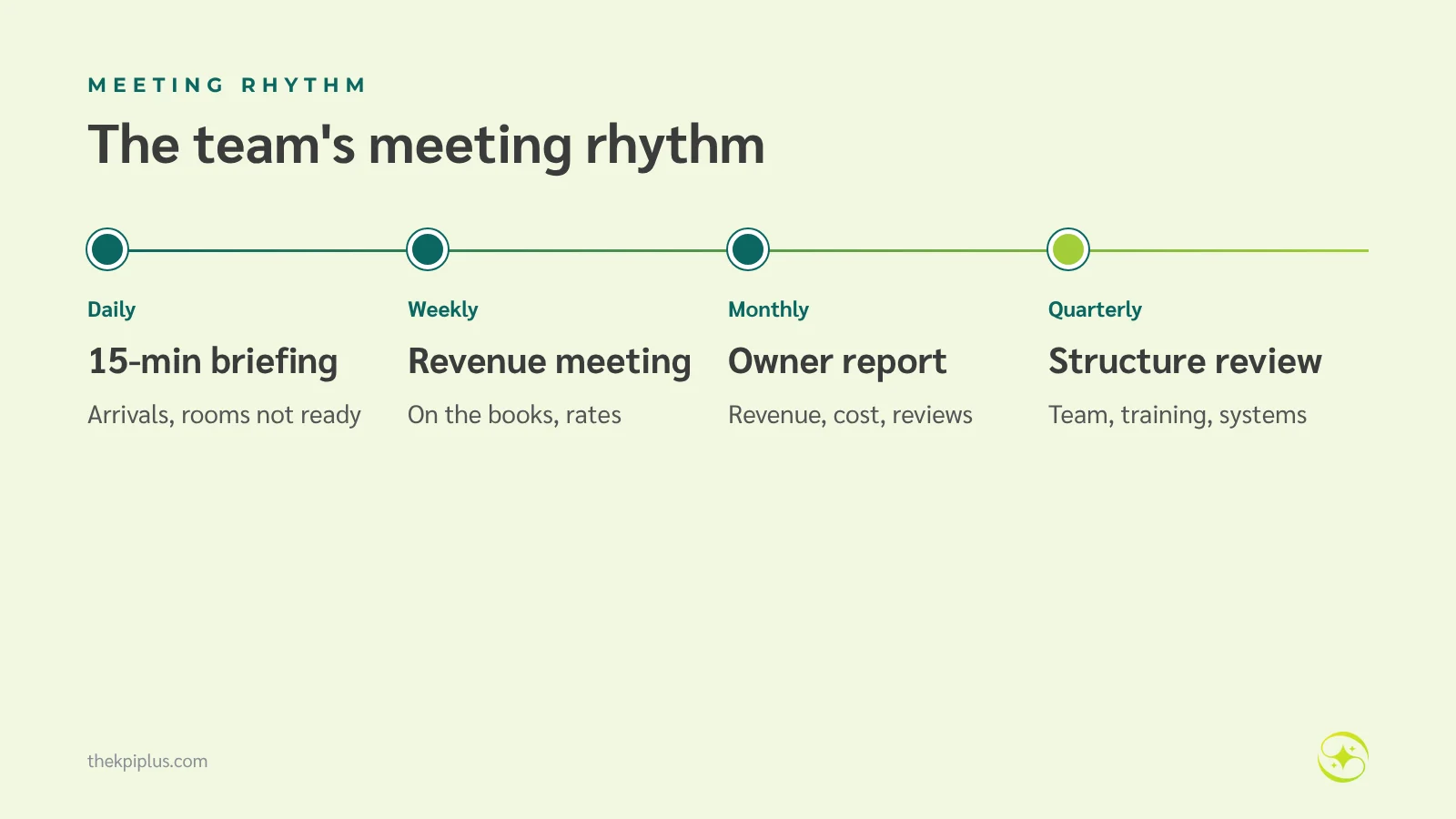
| Rhythm | Who attends | What's covered |
|---|---|---|
| Daily, 10–15 minutes | All supervisors | Arrivals, departures, rooms not ready, repairs, VIPs |
| Weekly | GM, reservations and sales | Bookings on the books, rates, channels |
| Monthly | GM and owner | Revenue, costs, reviews, next month's plan |
| Quarterly | GM and department heads | Team structure, training, systems |
Planning example: structure for a 25-room hotel
Imagine a 25-room boutique hotel serving breakfast only. A workable structure might have around 11–12 permanent staff.
| Role | Number | Extra responsibility |
|---|---|---|
| General manager | 1 | Rates and channels with reservations |
| Front office and reservations | 3 | Chat, email and direct-booking confirmations |
| Housekeeping | 4 | One acts as supervisor and inspects rooms before release |
| Technician | 1 | Repairs and pool |
| Breakfast | 2 | Help housekeeping late morning |
| Accounting | Outsourced | One front office staff member collects daily documents |
This is a planning example, not a result from any client. Actual headcount depends on occupancy, service level and Thai labour rules on working hours and days off.
Frequently asked questions
Does a small hotel need every department a large hotel has?
No. A small hotel doesn't need full departments, but every task needs an owner. One person may handle both reservations and pricing, or the head housekeeper may cover minor repairs. What matters is writing down who owns what, naming a backup when that person is away, and having someone in the hotel coordinate outsourced work such as accounting.
If we have a PMS, do we still need a channel manager?
If you sell through several OTAs and your website, you should have a channel manager or a PMS with one built in. It sends rates and availability to every channel at once and brings bookings back into the system, reducing overbooking risk. With only one or two channels you can manage manually, but you need a strict checking routine.
What should the GM of a small hotel focus on?
Three things: revenue (rates, channels and bookings on the books), service quality (reviews and recurring problems) and cost (labour cost per occupied room and main expenses). Other daily work should be covered by supervisors or clear procedures, so the GM has time for decisions that affect revenue.
Should we hire more staff or invest in systems first?
First check whether the heavy workload is repetitive work a system could do — pushing rates to OTAs, sending confirmations, compiling reports. If so, fix the system first. If it's guest-facing work that needs people, such as housekeeping or front office at check-in peaks, hire or redesign shifts. Systems reduce work but don't replace service staff.
How does organizational structure affect hotel revenue?
A clear structure stops revenue leaking unnoticed: rooms sold but not ready, bookings lost between channels, or rates nobody updates. When every task has an owner and information moves correctly, the sales team can sell every room, and guests get the experience that leads to good reviews and repeat stays.
Summary
A good hotel organizational structure isn't measured by the number of departments, but by whether every task has an owner, information is handed over completely, and systems remove repetitive work. Revenue, operations and support must talk every day. In 2026, with staff harder to find and costs higher, a small cross-trained team on a steady meeting rhythm is more reliable than a large team with unclear roles.
For help designing structure, procedures and KPIs, see independent hotel management. If you're choosing or changing systems, see hotel systems implementation and hotel training and team development. To find out where to start, request a Hotel Performance Audit.
Related reading: Small Hotel Marketing and Hotel Marketing Plan 2027.