Hotel Marketing
Hotel Marketing Plan 2027: How to Plan When Thailand's Market Isn't Growing (2026 Update)
A hotel marketing plan for 2027 in Thailand: targets by need dates, market mix, OTAs vs direct bookings, budget split and a quarterly plan.

In this article
What does 2026 tell us about planning for 2027?
The 2026 numbers say hotels shouldn't plan on the strong growth of past years. Nation Thailand reported on 5 November 2026 that Thailand received 25.46 million international arrivals from January to October 2026, down 4.59% year on year, with visitor spending down 2.85%. China remained the largest market, up 12.44%, while South Korea fell the most among the top ten.
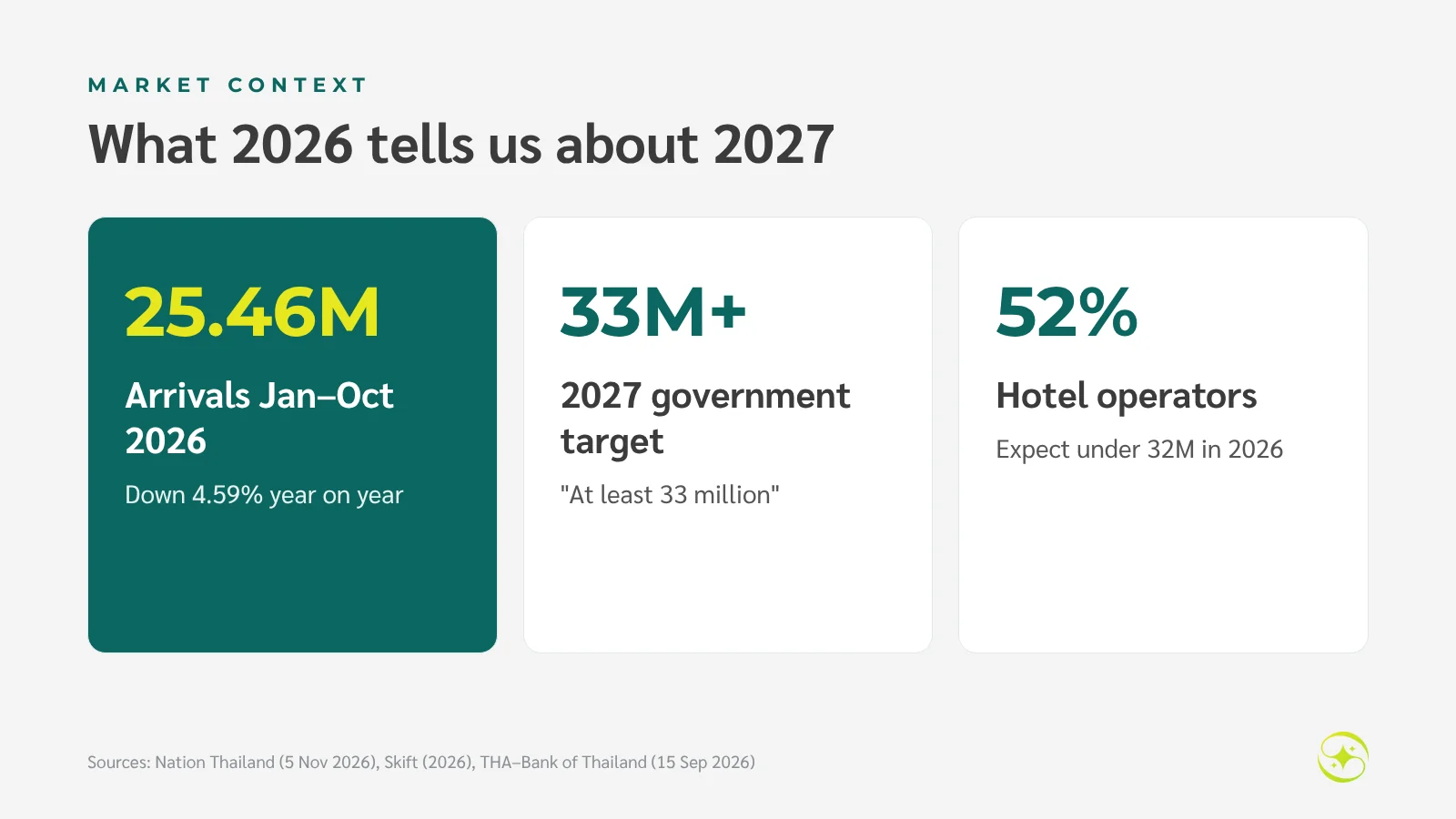
Skift reported that the government cut its 2026 forecast to 33 million and set a 2027 target of "at least 33 million". A Thai Hotels Association and Bank of Thailand survey released on 15 September 2026 found 52% of operators expected fewer than 32 million foreign arrivals this year, with travellers spending cautiously and shortening stays.
Search behaviour is shifting too. SiteMinder's Changing Traveller Report 2026 found OTAs overtook search engines as the top place guests start a hotel search (26% vs 21%), and since 27 August 2026 Google has let users in the United States search for and book hotels in one conversation in AI Mode.
What this means for hotels: 2027 is likely to be a flat market with choosier guests and fast-changing search paths. Your plan needs precision — spending on the dates that need bookings and judging results by net revenue rather than gross sales.
Where should a hotel marketing plan for 2027 start?
A plan that works starts from a demand calendar, not a list of activities. Work through four steps before choosing channels or content.
A plan that works starts from a demand calendar, not a list of activities. Work through four steps before choosing channels or content.
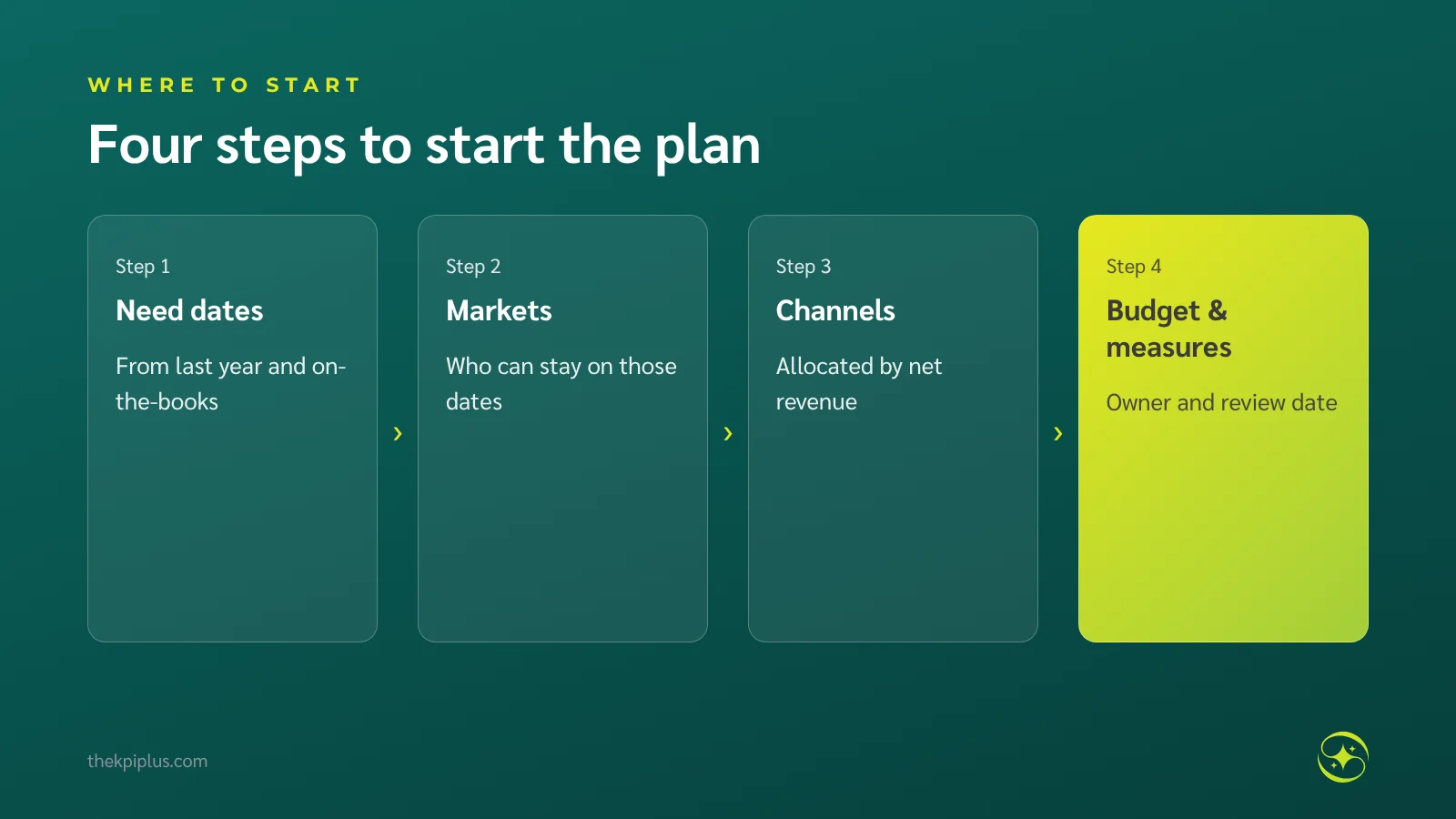
1. Identify the dates that need bookings from last year's data and what's on the books — low season, weekdays, the weeks after long holidays.
2. Choose markets and guest segments that can realistically stay on those dates.
3. Allocate channels by net revenue after cost, not gross bookings.
4. Split the budget and set measures so every task has an owner and a review date.
1. Set targets by need dates and net revenue
A useful marketing target says how many extra room nights you need, in which months, at what ADR. "Add 300 room nights in May–June at an ADR of at least THB 2,400" beats "raise brand awareness" because the team knows what to do and how to measure it.
Do this: pull two years of monthly bookings by channel and market, and flag months where occupancy fell more than ten points below target. That's where your marketing budget should go first.
Measure: room nights and RevPAR for the target months against last year.
2. Spread your markets
2026 showed how quickly international markets can swing — some up, some down by double digits in a single year. A 2027 plan needs a core market, secondary markets and a domestic market for weekdays and low season.
| Market | Role in the plan | Suitable channels |
|---|---|---|
| Core (largest last year) | Protect the revenue base | Main OTAs, direct bookings from past guests |
| Long-haul (Europe, Australia) | Longer stays, higher ADR in high season | International OTAs, English-language Google |
| Domestic | Fill weekdays and low season | Social media, LINE, short packages |
| Corporate and groups | Fill predictable periods | Direct sales, tour operators |
Watch out: don't move your whole budget to whichever market is growing in the news. Check your own booking data to see whether that market actually books hotels like yours in your location.
3. Let OTAs bring new guests — then make direct booking easy
OTAs help guests who don't know you find you, but every booking carries commission. A good plan doesn't cut OTAs; it compares net revenue by channel and makes direct booking easy for guests who already know you — past guests and people searching your hotel's name.
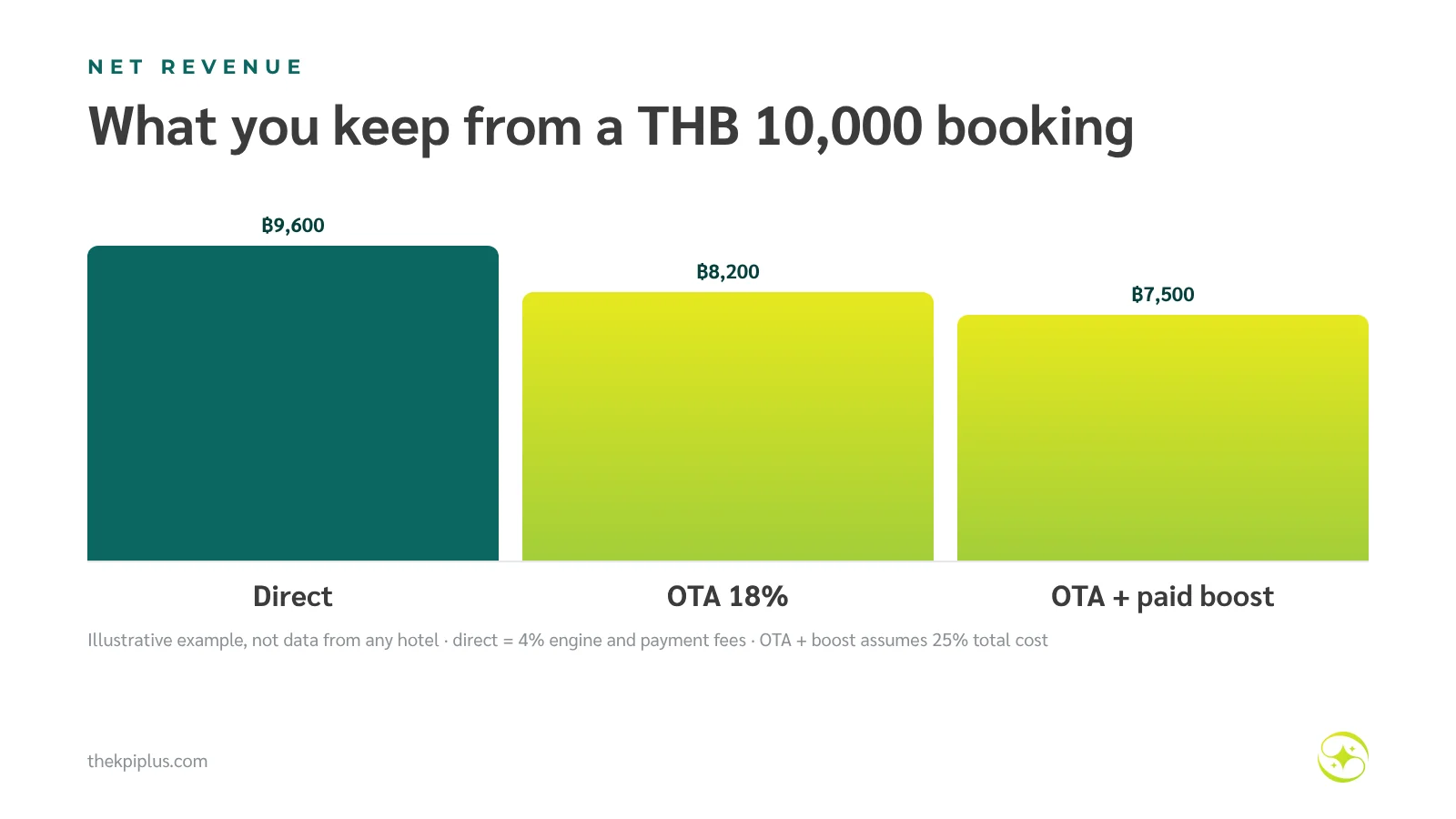
Example: a THB 10,000 booking through an OTA at 18% commission leaves THB 8,200. A direct booking with 4% in booking-engine and payment fees leaves THB 9,600. The THB 1,400 difference per booking is budget you can invest in direct-booking marketing. These are illustrative figures; actual commission depends on each hotel's contract.
Try The KPI Plus OTA commission calculator (in Thai) to compare net revenue by channel with your own numbers.
4. Make Google, your website and OTAs tell one story
When guests search through Google, OTAs and AI at the same time, inconsistent information erodes trust — and AI tools can repeat the errors. Your 2027 plan should include a quarterly check of the basics: name, address, room types, facilities, policies, photos and prices.
Do this: build a table comparing your hotel's details on your website, Google Business Profile and your two main OTAs, and fix every mismatch in the first month of the year.
5. Build content from experiences you actually deliver
Choosier guests want a clear reason to stay with you. Content that works comes from what your hotel does every day — a breakfast built on local produce, a beach walking route, rooms designed for families — not from broad advertising claims.
- Plan monthly content themes around the dates you need to sell
- Use reviews and guest photos (with permission) as evidence
- Give every post a next step: a booking link or a way to ask
6. Use AI where quality can be checked
AI saves a lot of repetitive work, but only where accurate data exists and a person reviews the output: chat drafts from room information, monthly review summaries, page translations, weekly booking summaries. Don't let AI quote prices or confirm availability without pulling from your booking system.
Numbers to watch: hours saved per month · time to first chat reply · errors caught in review
7. Split the budget into three and review every quarter
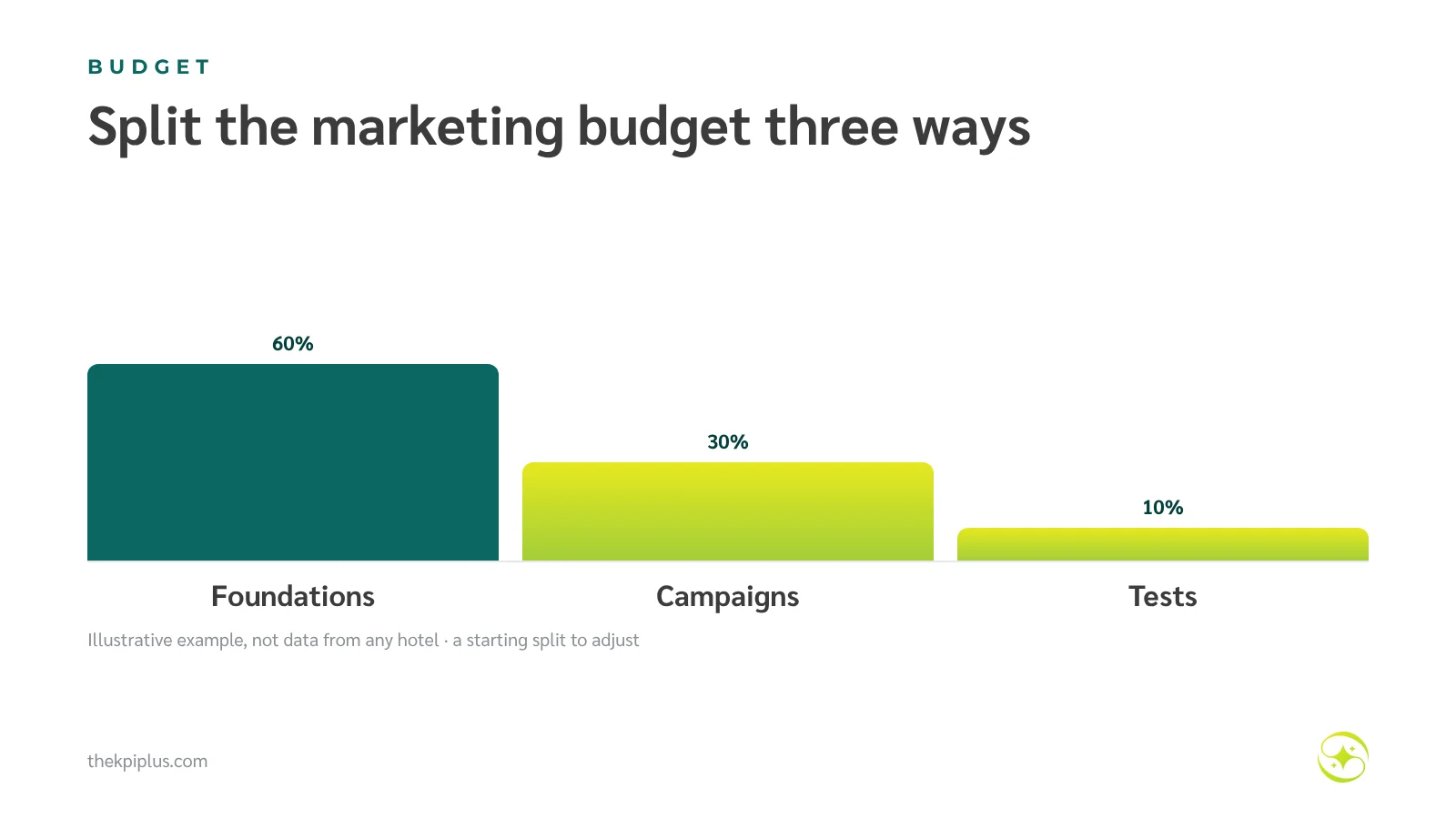
A flexible hotel marketing plan splits the budget into foundations you run every month, campaigns for the dates your calendar flags, and a small test budget. Tests need clear rules for when to scale up and when to stop.
| Budget block | Example work | Measured by |
|---|---|---|
| Foundations (about 60%) | Website, booking engine, Google Business Profile, brand-name search ads | Direct booking share, net revenue |
| Campaigns (about 30%) | Low-season ads and packages | Room nights in target months |
| Tests (about 10%) | New channels or markets | Cost per booking against a set threshold |
The split is a starting point, not a formula. The hotel budget calculator (in Thai) can help you set the annual numbers.
A quarterly plan for 2027
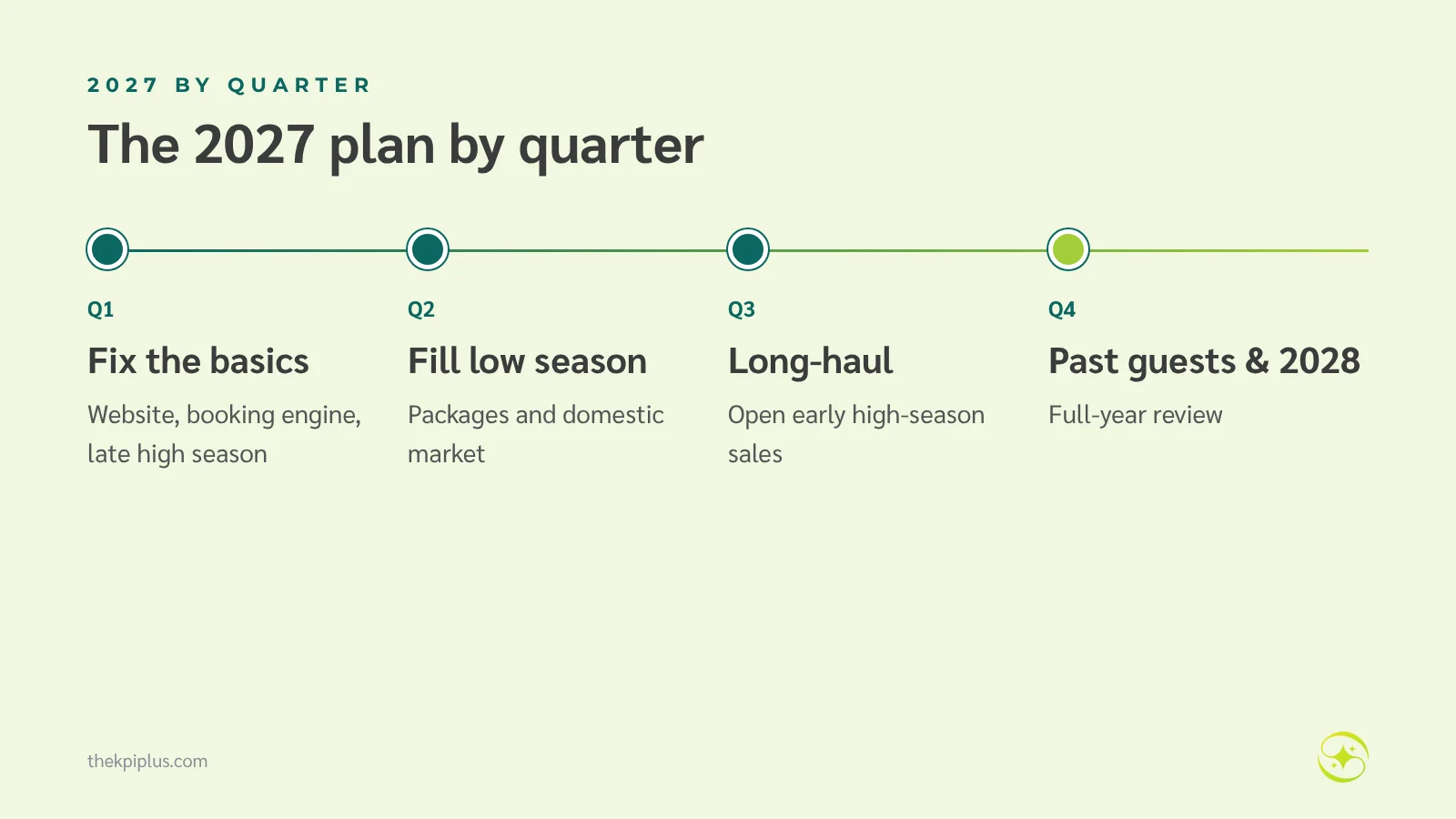
Splitting work by quarter shows the team the sequence and creates a natural review every three months.
| Quarter | Main work |
|---|---|
| Q1 | Check all channel information, improve website and booking engine, sell late high season |
| Q2 | Low-season packages and campaigns for the domestic market |
| Q3 | Open early high-season sales to long-haul markets; test a new channel |
| Q4 | Past-guest communication, full-year review, plan 2028 |
Planning example: a 50-room hotel in Phuket
Imagine a 50-room hotel at 68% occupancy this year with an ADR of THB 2,800. From May to September occupancy sits around 52%, and 70% of bookings come through OTAs.
A 2027 plan could aim to lift May–September occupancy to 57% — roughly 380 extra room nights (50 rooms × 153 days × 5%) — and raise the direct share from 20% to 25% without lowering ADR. Budget goes first to the website and booking engine, then brand-name Google search ads, weekday domestic packages and past-guest communication. This is a planning example, not a result from any client.
Frequently asked questions
When should a hotel start its marketing plan for the next year?
Start drafting in October or November and finish before the new year, because you need on-the-books data for the first quarter and the high-season rates you are already selling. Then review it monthly in your revenue meeting and adjust it each quarter based on actual results. Don't write it once and leave it for twelve months.
How much should a small hotel spend on marketing?
There's no single right figure. A workable method is to set the budget as a share of target room revenue, then split it into ongoing foundations, campaigns for the dates you need, and a small test budget. What matters is measuring bookings and net revenue, not clicks or followers.
Should we cut OTAs to grow direct bookings?
Not necessarily. OTAs still help new guests discover you — SiteMinder found they were the number-one starting point for hotel searches in 2026. Look at net revenue after commission for each channel, and make it easy for guests who already know you, such as past guests and people searching your name, to book direct.
How should AI be used in a hotel marketing plan?
Use it for work backed by accurate data that someone can check: drafting chat replies from correct room information, summarising reviews, translating content or analysing weekly bookings — always with human review. Also keep your hotel's information complete and consistent across your website, Google and OTAs so AI tools describe you correctly.
Which numbers should measure a hotel marketing plan?
Start with revenue numbers — occupancy, ADR and RevPAR — then net revenue by channel after commission and advertising, the direct booking share, and booking pace for the months ahead. Website traffic and followers show whether work is on track, but they are not the goal.
Summary
A hotel marketing plan for 2027 should start from need dates and net revenue, spread markets, use OTAs for discovery while making direct booking easy, keep information consistent everywhere, apply AI where quality can be checked, and split the budget into three blocks reviewed every quarter. In a flat market, hotels that plan from real numbers get more from every baht.
To connect your marketing plan with pricing, channels and revenue targets, see revenue and commercial management or our hotel revenue management overview. To start your 2027 plan from your own data, request a Hotel Performance Audit.
Related reading: 10 Hotel Marketing Strategies and Hotel Rate Parity.