SEO / Local Search
Hotel SEO: How to Get Your Hotel Website on Page One of Google (2026 Update)
Hotel SEO for owners in Thailand: searches you can win, technical basics, pages to build, Google Maps, links and a 90-day plan measured in bookings.
In this article
What changed in 2026: more frequent ranking updates, and AI that books
Google has released three core updates in 2026 — in March, May and November. Search Engine Journal reported that the May update began on 21 May and was the fourth confirmed ranking update of the year. Google describes these updates as designed to surface relevant, satisfying content.
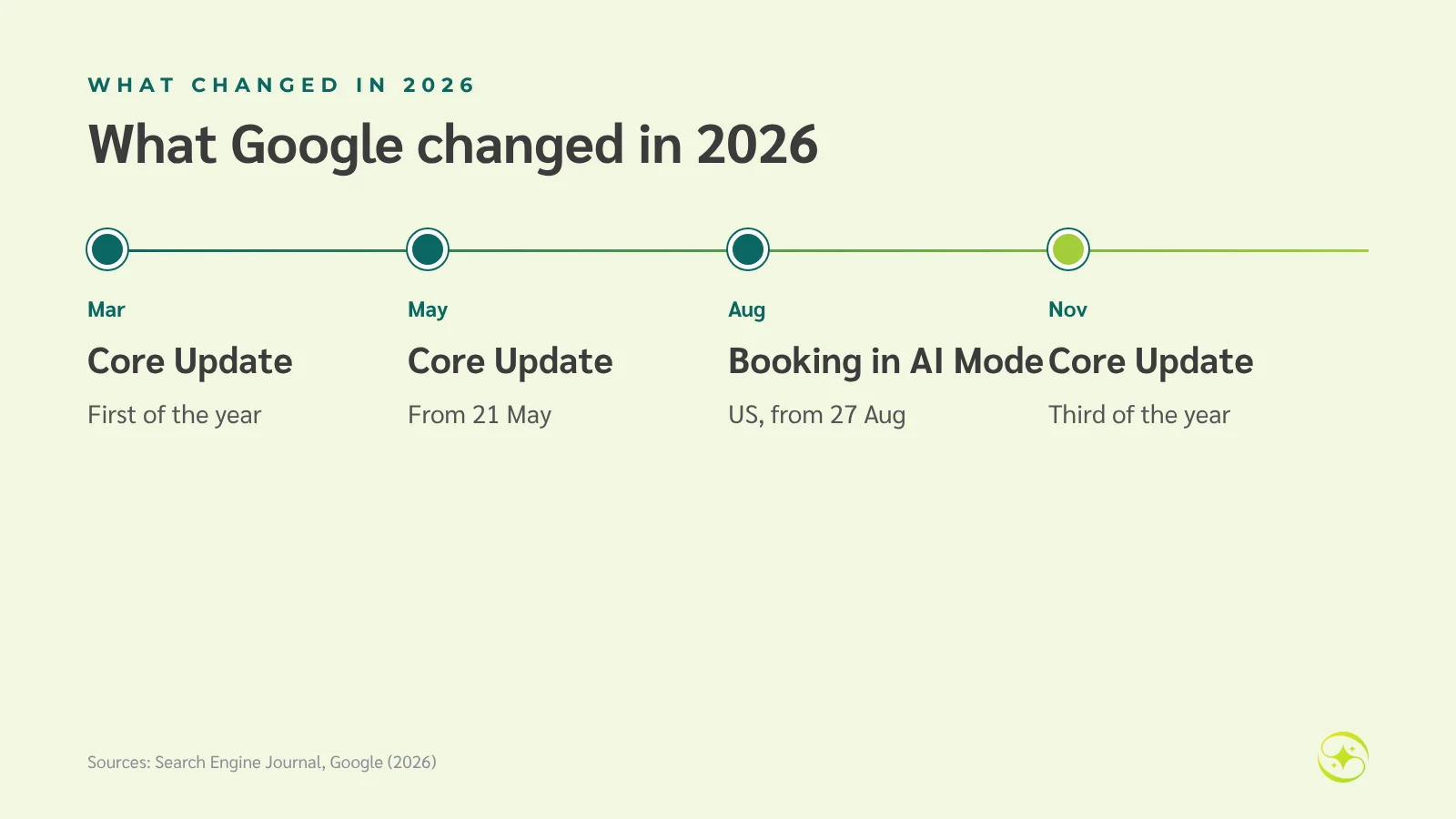
Search is also becoming conversational. Since 27 August 2026, Google has let users in the United States search, compare and book hotels in one conversation in AI Mode, and SiteMinder's Changing Traveller Report 2026 found OTAs have overtaken search engines as the top starting point for hotel searches.
What this means for hotels: shortcuts to push rankings become riskier with every update. What lasts is a website with accurate, complete information that matches every other channel — because Google and AI tools both rely on that information.
Which searches can hotel SEO realistically win?
Before starting, split searches into four types. Each has different winners and needs different work.
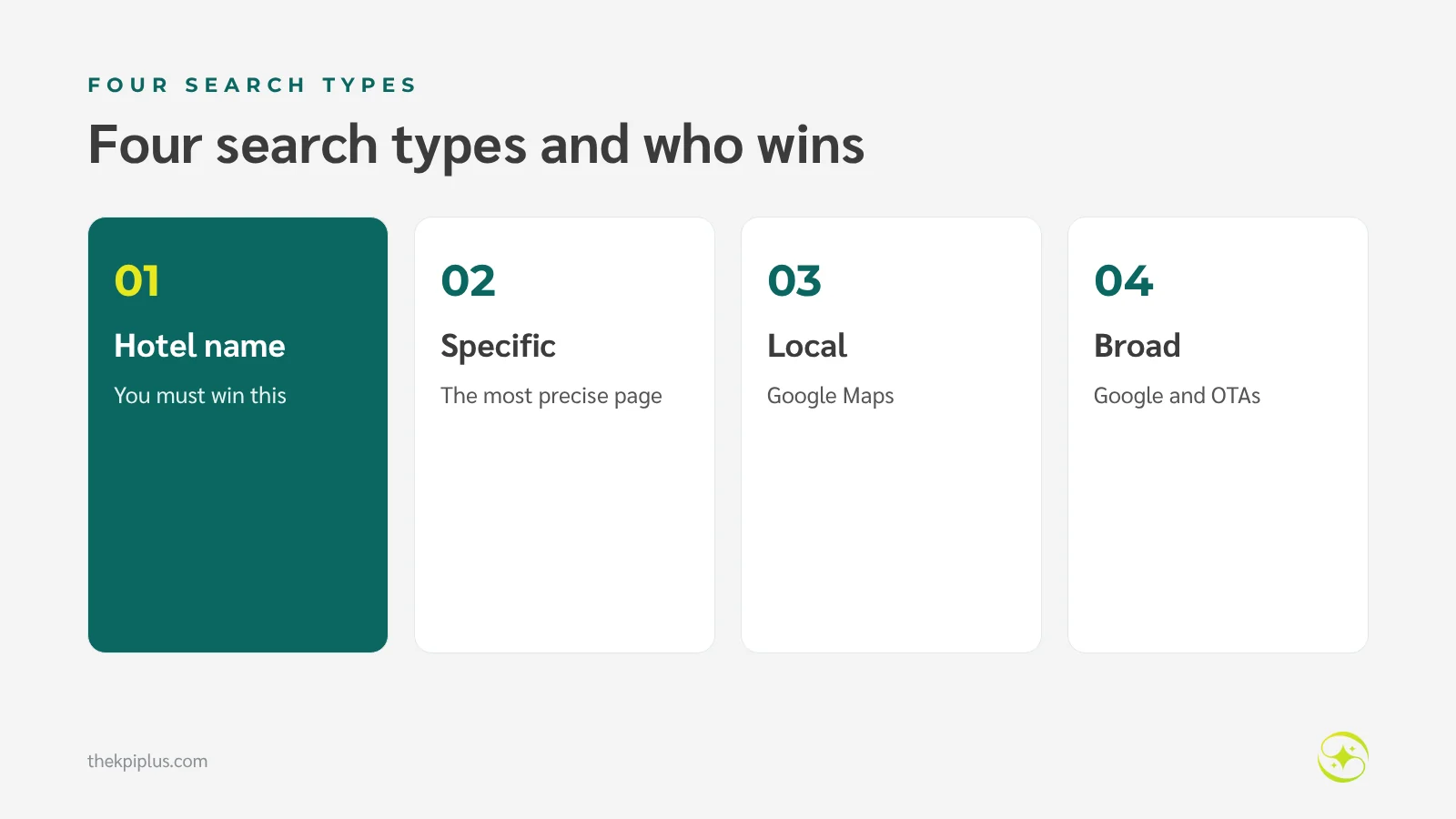
| Search type | Example | Usually won by | Your chance |
|---|---|---|---|
| Hotel name | "[hotel name] Kata" | Your website or an OTA | Very high — you must win it |
| Specific | "family hotel with pool near Kata Beach" | The page that answers most precisely | High, with the right page |
| Local | "hotels near me", "hotel near the airport" | Google Maps | High, with a complete profile and reviews |
| Broad | "hotels in Phuket" | Google's hotel module and OTAs | Low — use ads or OTAs instead |
Watch out: if an SEO provider guarantees the top spot for "hotel + province", ask how, and whether they report bookings. Google itself says no one can guarantee rankings.
1. Win your hotel-name searches first
People searching your name are closest to booking. If an OTA ranks above your own website, you're paying commission on guests who already found you.
- Your homepage title should include your name and location, e.g. "[Hotel name] | Hotel near Kata Beach, Phuket"
- Keep name, address and phone identical across your website, Business Profile and OTAs
- Add a direct booking link to your Business Profile and enable free booking links through a supported booking engine
Measure: in Google Search Console, check click-through rate on your brand searches. A low CTR means OTA results or ads are taking those clicks.
2. Make sure Google can reach and understand every page
Great content doesn't help if Google can't reach the page or it loads slowly on mobile. Technical basics come before content work.
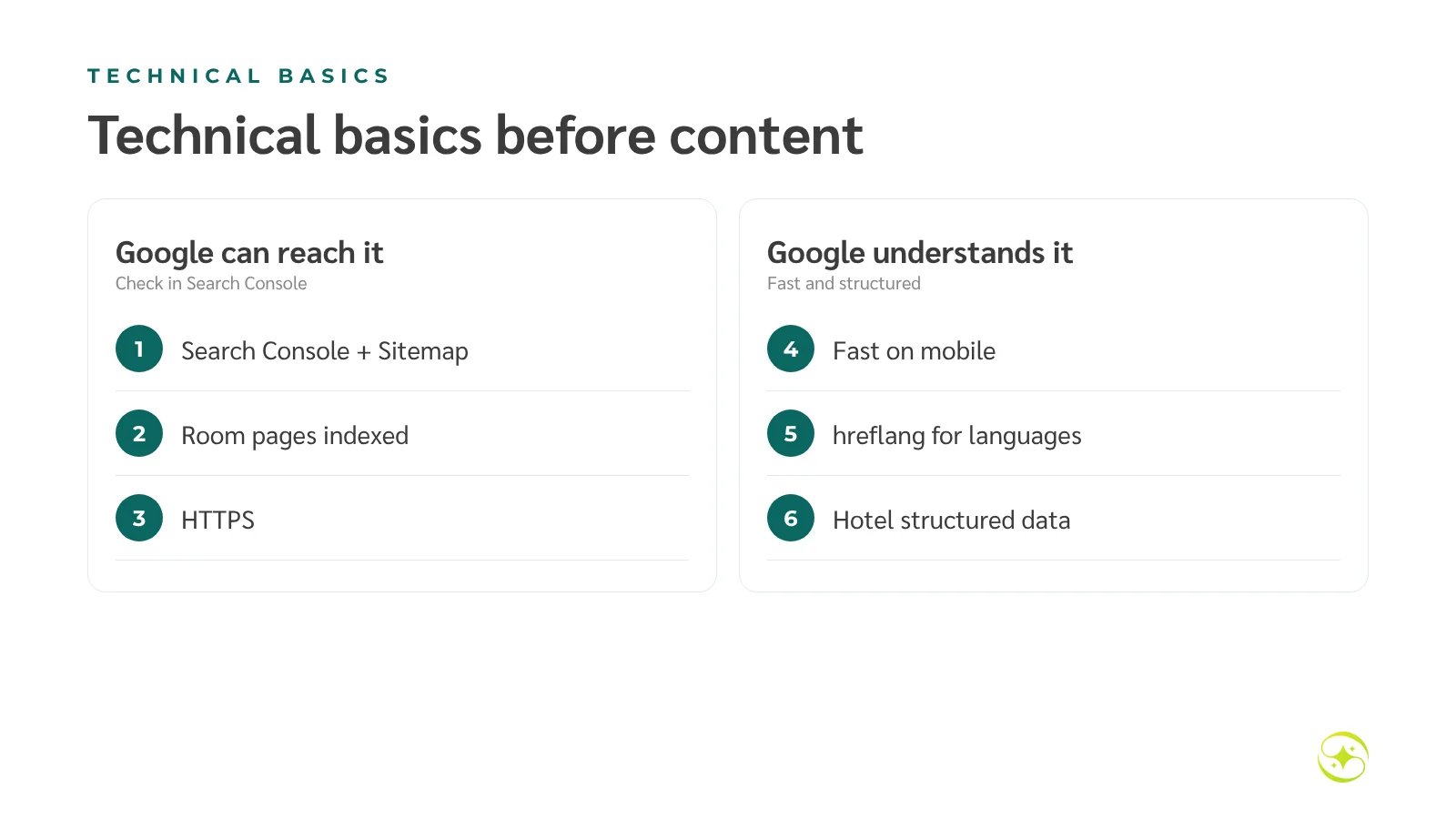
- Connect Google Search Console and submit a sitemap
- Check that every room page is indexed
- Use HTTPS and keep pages fast on mobile, especially room photos
- For multiple languages, give each its own URL and use hreflang
- Add Hotel structured data with your real name, address and amenities
The KPI Plus hotel searchability check (in Thai) gives a quick first view of what to fix on your website and Google listing.
3. Build pages that answer specific searches
Each page should answer one question completely rather than putting everything on the homepage. Hotel websites that rank for specific searches usually have these pages.
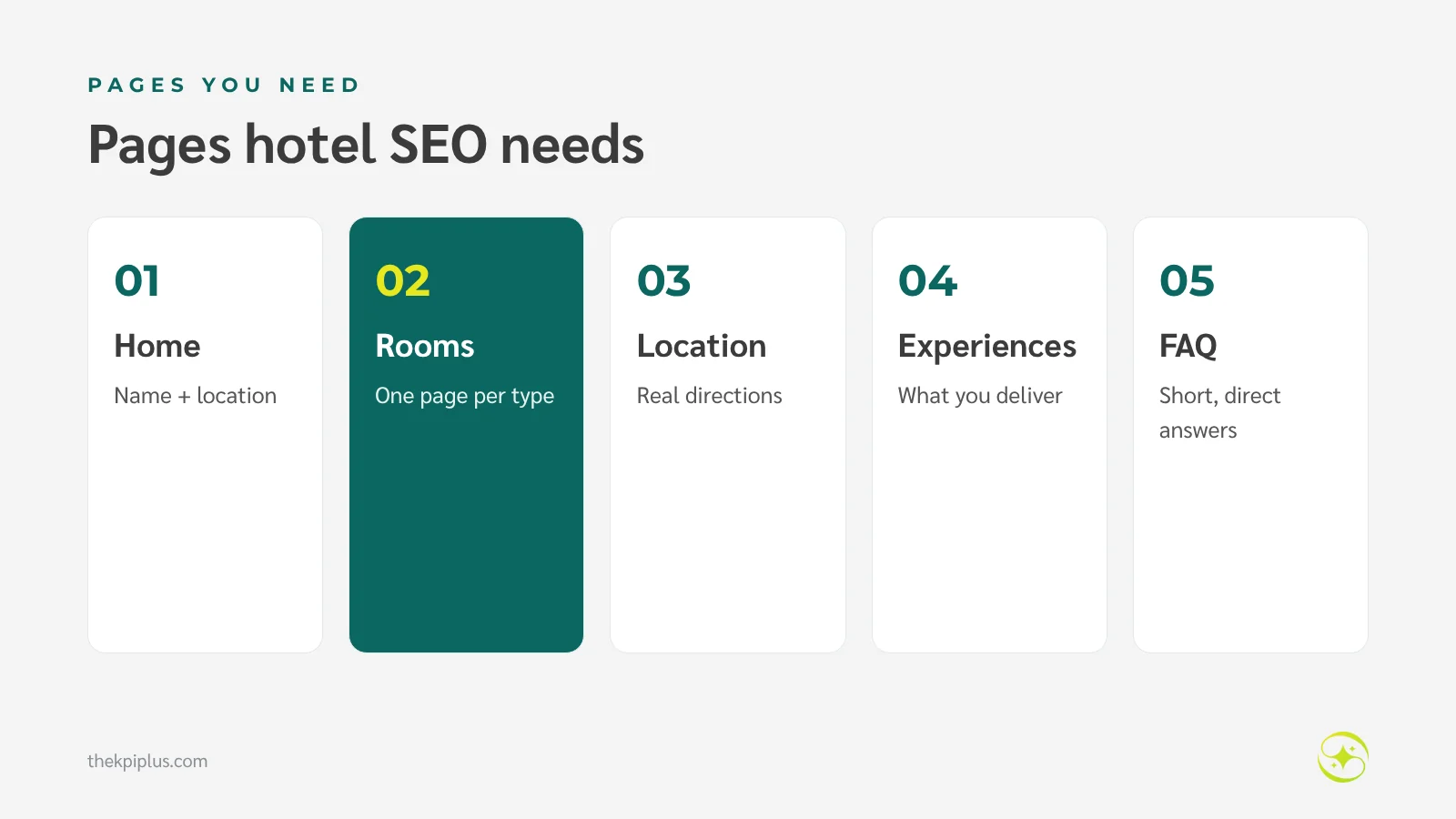
| Page | Answers searches like | Must include |
|---|---|---|
| Each room type | "family room for four" | Size, beds, occupancy, view, real photos |
| Location and getting here | "hotel near Kata Beach" | Real distances, airport transfer, map |
| Experiences | "quiet honeymoon hotel" | What you actually deliver, photos, reviews |
| FAQ | "check-in time", "is there parking" | Short, direct answers matching real policy |
Each page needs an easy-to-find rates or booking button — the goal of SEO is bookings, not visits.
4. Manage Google Maps alongside your website
For local searches, Google often shows the map before website results. A complete Business Profile with steady reviews is part of hotel SEO, not a separate project. Check your category, hotel details, amenities, photos and website link match your site.
5. Earn mentions from relevant sources
Links and mentions from other websites still help Google trust you — but they must come from relevant sources: your provincial hotel association, partner restaurants and activities, travel media, or bloggers who actually stayed.
Watch out: never buy links in bulk from unrelated sites. Google treats it as spam, and it can pull down the whole site after an update.
6. Measure hotel SEO in bookings, not just rankings
Rankings change daily and differ by the searcher's location. Report clicks from Search Console and bookings or revenue from organic search in Google Analytics or your booking engine.
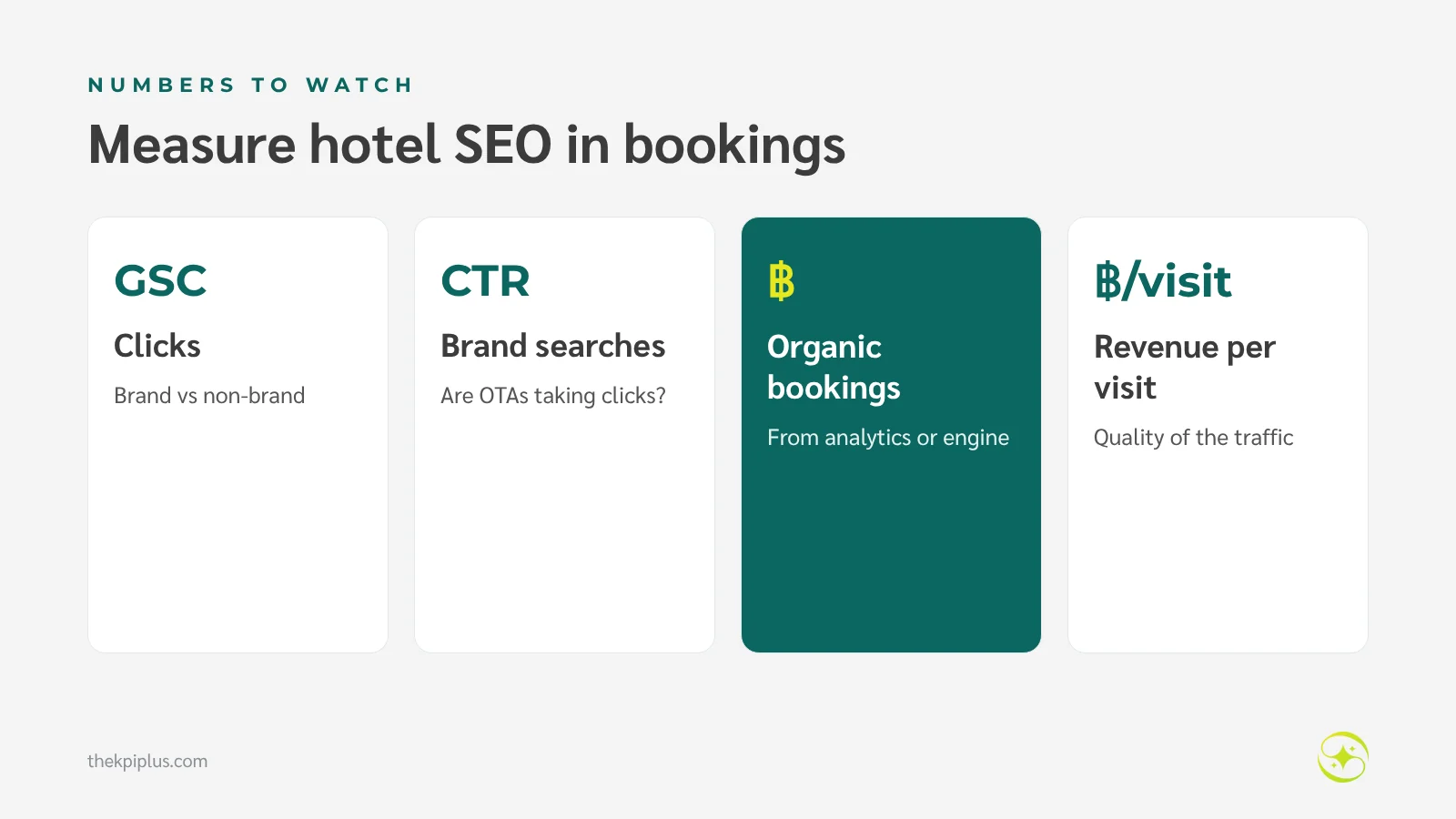
Numbers to watch: Search Console clicks (brand vs non-brand) · brand-search CTR · bookings from organic search · revenue per visit
A 90-day hotel SEO plan
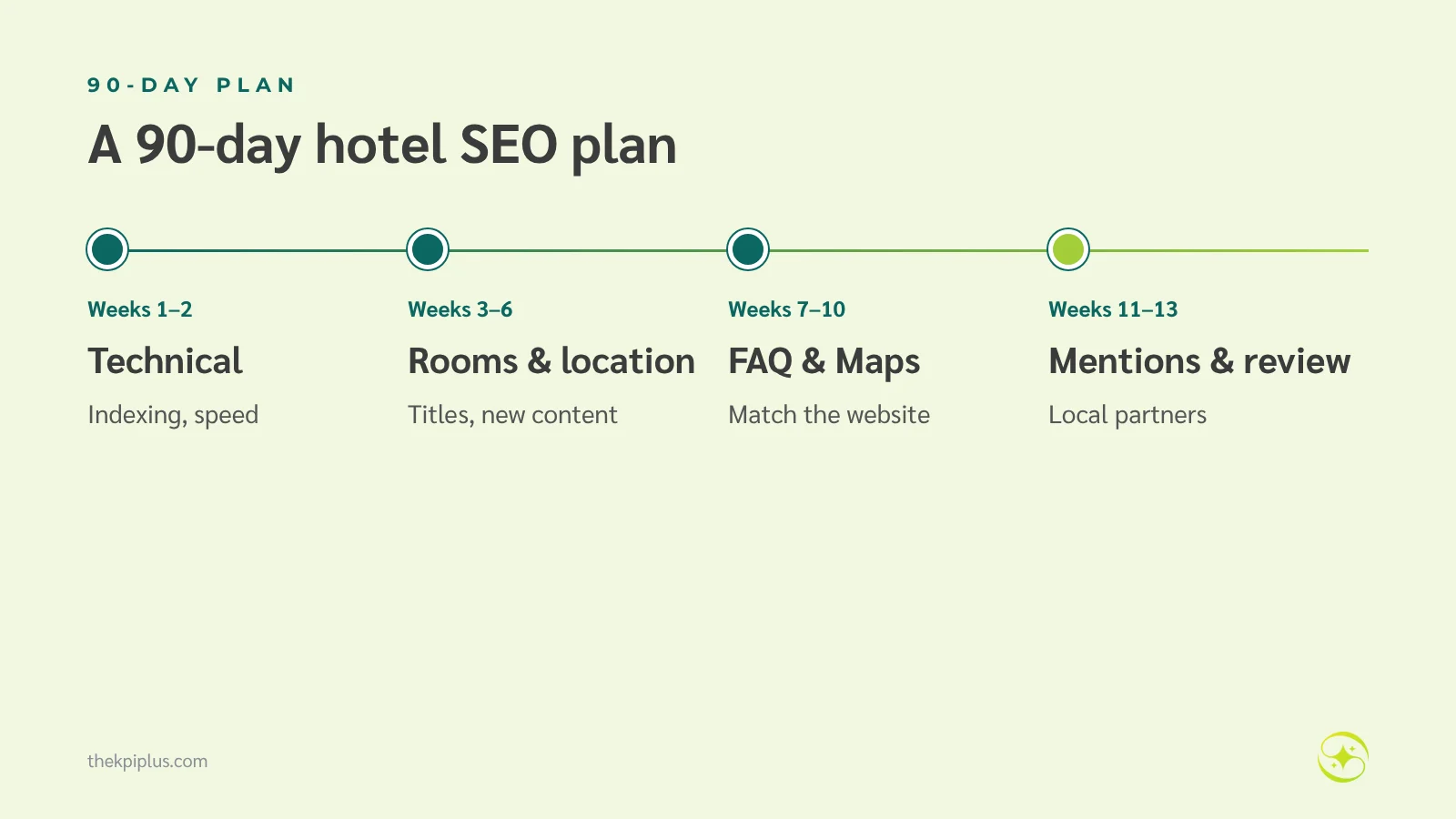
Start with technical work, then the pages closest to booking, then outside mentions. This 90-day plan suits most independent hotels.
| Period | Main work |
|---|---|
| Weeks 1–2 | Connect Search Console, fix unindexed pages, check mobile speed |
| Weeks 3–6 | Rewrite titles and descriptions; rebuild room and location pages |
| Weeks 7–10 | Build the FAQ page; align Business Profile with the website |
| Weeks 11–13 | Reach out to local partners; first results review; plan next quarter |
Planning example: a 35-room hotel near Kata Beach
Imagine a 35-room hotel whose website gets 1,200 Google clicks a month, almost all from its own name — yet an OTA ranks first for that name, and all room types sit on a single page.
After splitting rooms into three pages, writing a "Phuket airport to Kata Beach" guide and fixing the homepage title, the hotel might target 300 non-brand clicks a month within six months. At a 1.5% booking rate, that's four or five extra commission-free bookings a month. This is a planning example, not a result from any client.
Frequently asked questions
How long does hotel SEO take to show results?
Foundational fixes — indexing, page titles, room pages — usually show changes in Search Console within four to eight weeks. Ranking for competitive searches typically takes three to six months or more, depending on your site's starting point and local competition. Track progress monthly rather than waiting for a single result.
Can our website rank on page one for 'hotels in Phuket'?
It's very hard for an independent hotel. For broad searches like this, Google usually shows its own hotel module and OTA pages at the top. More realistic targets are specific searches — by location, trip type or facility — and Google Maps rankings for local searches, which lead to bookings more reliably.
Do we need to publish blog posts every week?
No. For hotels, the most important pages are room pages, location and getting-here pages, and FAQs. Complete those first, then add articles that answer real guest questions, such as transfers from the airport. One or two strong articles a month beat many thin ones.
Does hotel SEO help AI tools recommend our hotel?
Indirectly, yes. AI tools such as Google's AI Mode draw on search results, Google Maps, reviews and websites. When your site gives complete, clear information that matches your Business Profile and OTA listings, AI is more likely to describe your hotel correctly — but nobody can guarantee an AI will recommend a particular hotel.
What should a hotel SEO agency deliver, and what should we avoid?
A good service starts by auditing your website and Business Profile, maps keywords to existing pages, improves content and technical issues, and reports clicks, bookings and revenue from Search Console and analytics. Avoid anyone who guarantees the number-one spot, buys links in bulk, or reports only rankings without bookings.
Summary
Effective hotel SEO starts with targets you can win — your name, specific searches and local searches — then fixes technical basics, builds complete room, location and FAQ pages, manages Google Maps alongside the site, and measures bookings. With frequent Google updates and AI starting to book on users' behalf, a website with accurate, complete information is the safest investment.
To plan website, Google Maps and AI search work together, see hotel SEO, Google Maps and AI Search and our hotel SEO and local search overview. To see where your hotel stands, request a Hotel Performance Audit.
Related reading: Hotel Website Content and Local SEO for Hotels.